 KitCut
Best AI image generator 2026: 8 models, 96 pictures, every answer checked
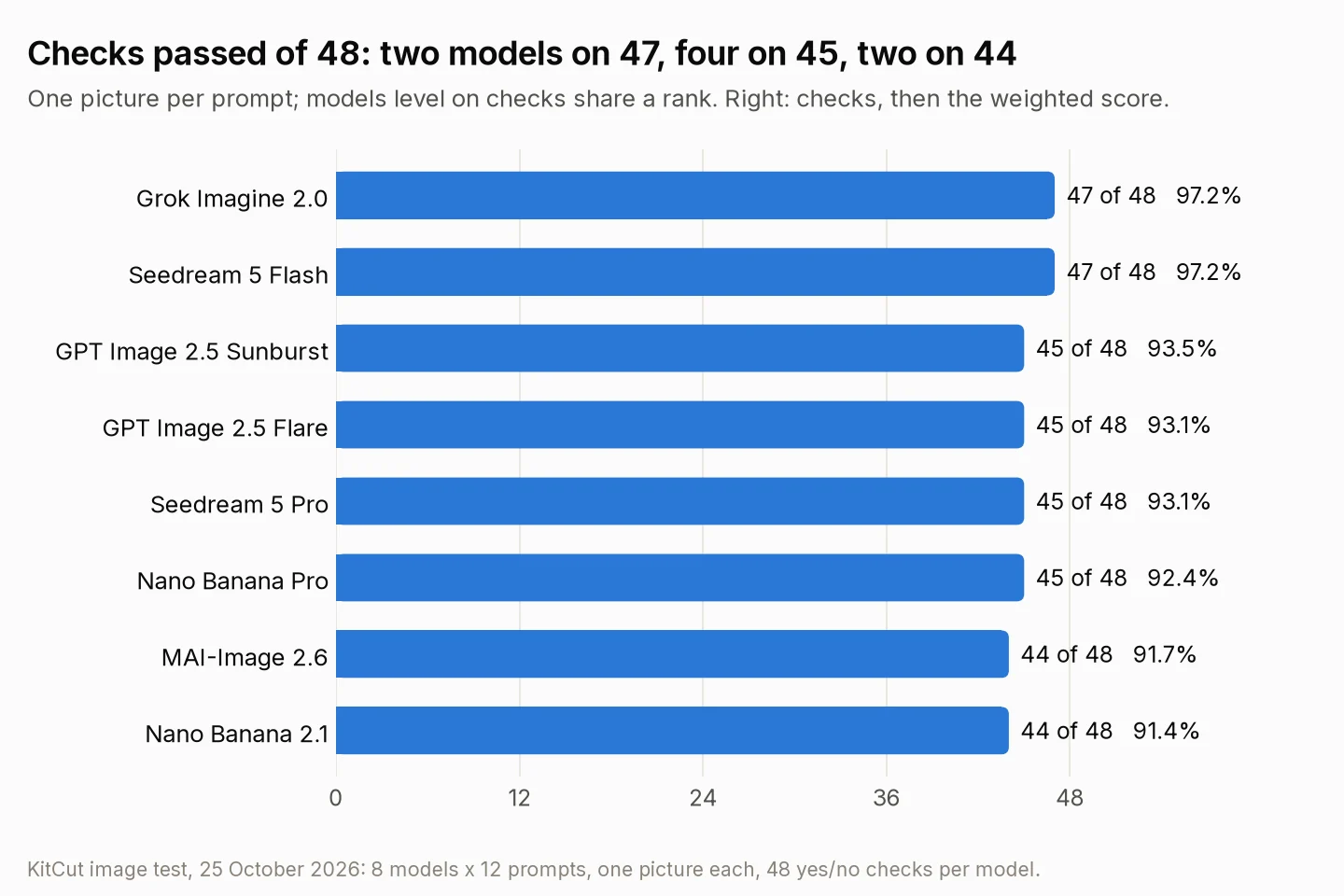
We gave eight AI image generators the same 12 prompts and checked each model's 12 pictures against 48 yes/no questions. Seedream 5 Flash and Grok Imagine 2.0 tied for first on 47 of 48 checks, but Seedream 5 Flash cost $0.018 a picture and took 11.4 seconds where Grok Imagine 2.0 cost $0.060 and took 54.4. Four more passed 45, including GPT Image 2.5 Sunburst and Flare, the cheapest; the lowest passed 44. All eight drew people and products correctly; they differed on a piano keyboard, an empty street and exact text.
If you want one model: Seedream 5 Flash, tied first on 47 of 48 checks, at $0.018 and 11.4 seconds a picture. Cheapest and fastest: GPT Image 2.5 Flare, at $0.013 and 10.6 seconds, two checks behind. With one picture per prompt, a gap that size could close on a re-run, so weigh price and speed as much as the score.
Updated 25 October 2026. We made all 96 pictures that day through one API and scored them blind. How we tested, and the limits, are at the end.
Key findings
- Two models tie for first, and the field is close. All eight passed 44 to 47 of 48 checks: two on 47, four on 45 and two on 44. With one picture per prompt, a one-check gap is noise, and a two-check gap could close on a re-run.
- Most prompts separated no one. All eight passed every check on eight of the 12 prompts, among them counting fruit, putting each colour on the right child, a photoreal portrait and a watercolour.
- Every model failed the piano. None drew the black keys in their real groups of two and three. The hands came out well: no judge reported an extra or fused finger, and all eight passed the fingers check once a finger hidden by the camera angle counted as hidden, not missing.
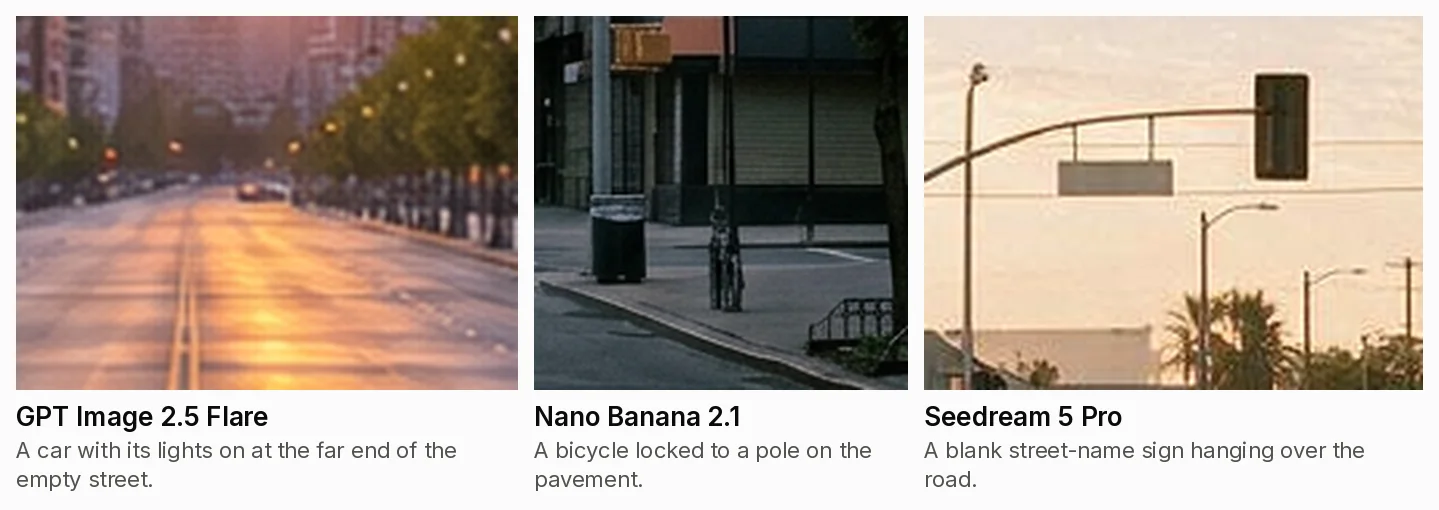
- “No cars, no signs” is hard. Only Grok Imagine 2.0 and Seedream 5 Flash left out every car, sign and person on the empty-street prompt.
- Text is nearly solved, in English and in Ukrainian. All eight spelt GRAND OPENING, KITCUT and “Кава з собою” correctly. Five of the eight passed all 23 checks on the five prompts with words in them, OCR included.
- Price does not buy score. The dearest model, Nano Banana Pro, cost 10 times as much per picture as the cheapest, GPT Image 2.5 Sunburst and Flare, and passed the same 45 checks.
Which AI image generator is best?
On our 12 prompts, Seedream 5 Flash and Grok Imagine 2.0 tied for first: each passed 47 of the 48 checks, missing only on the piano, for a score of 97.2%. Between the two, price and speed decide it. Seedream 5 Flash cost $0.018 a picture and took a median of 11.4 seconds; Grok Imagine 2.0 cost $0.060 and took 54.4. Behind them the field is close: four models passed 45, two checks fewer, and the lowest passed 44. A two-check lead is small in a test this size, so pick on the job, the price and the speed as much as on the score. For words in a picture, five of the eight passed every check. On price, GPT Image 2.5 was the cheapest at $0.013 a picture, with 45 checks. On speed, GPT Image 2.5 Flare was quickest, at 10.6 seconds.
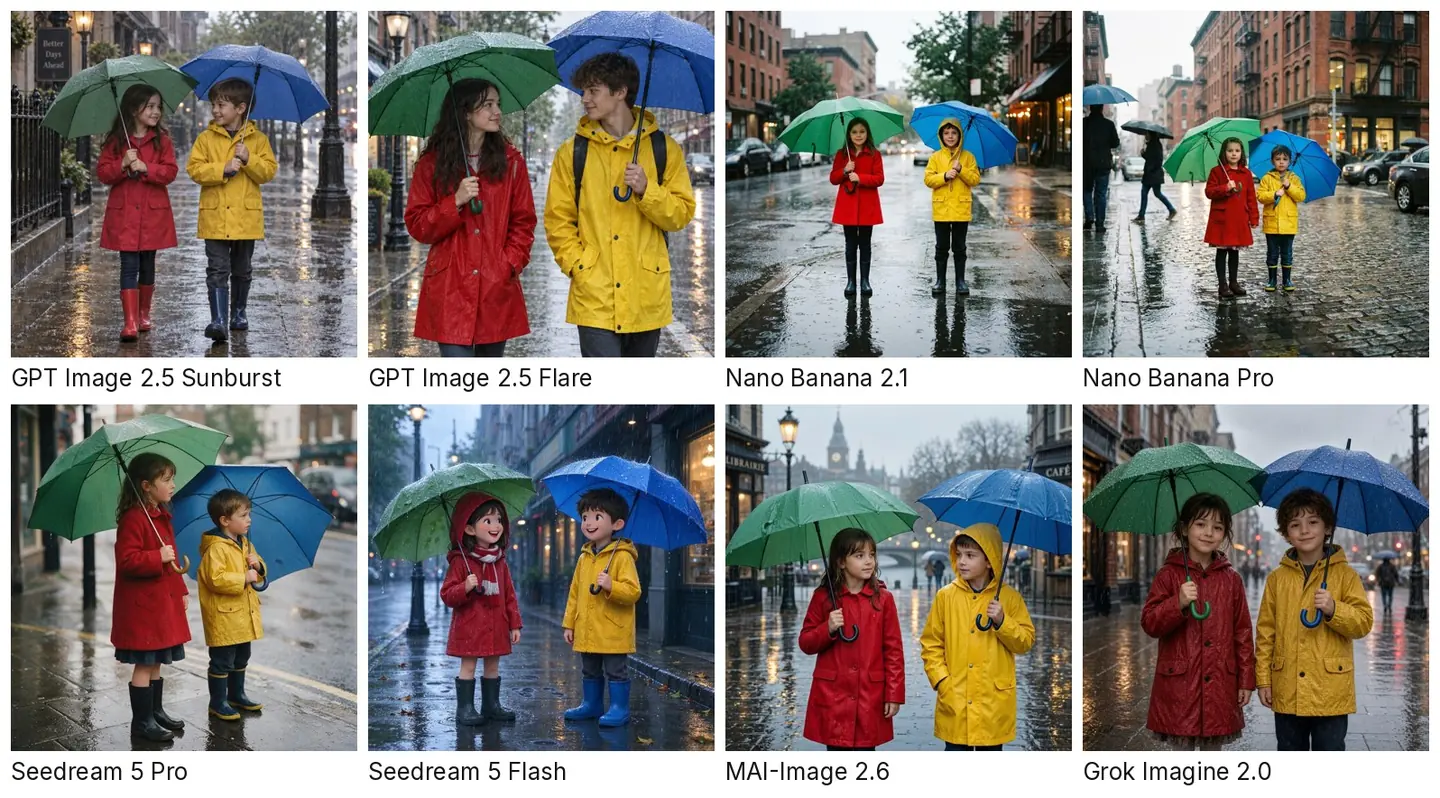
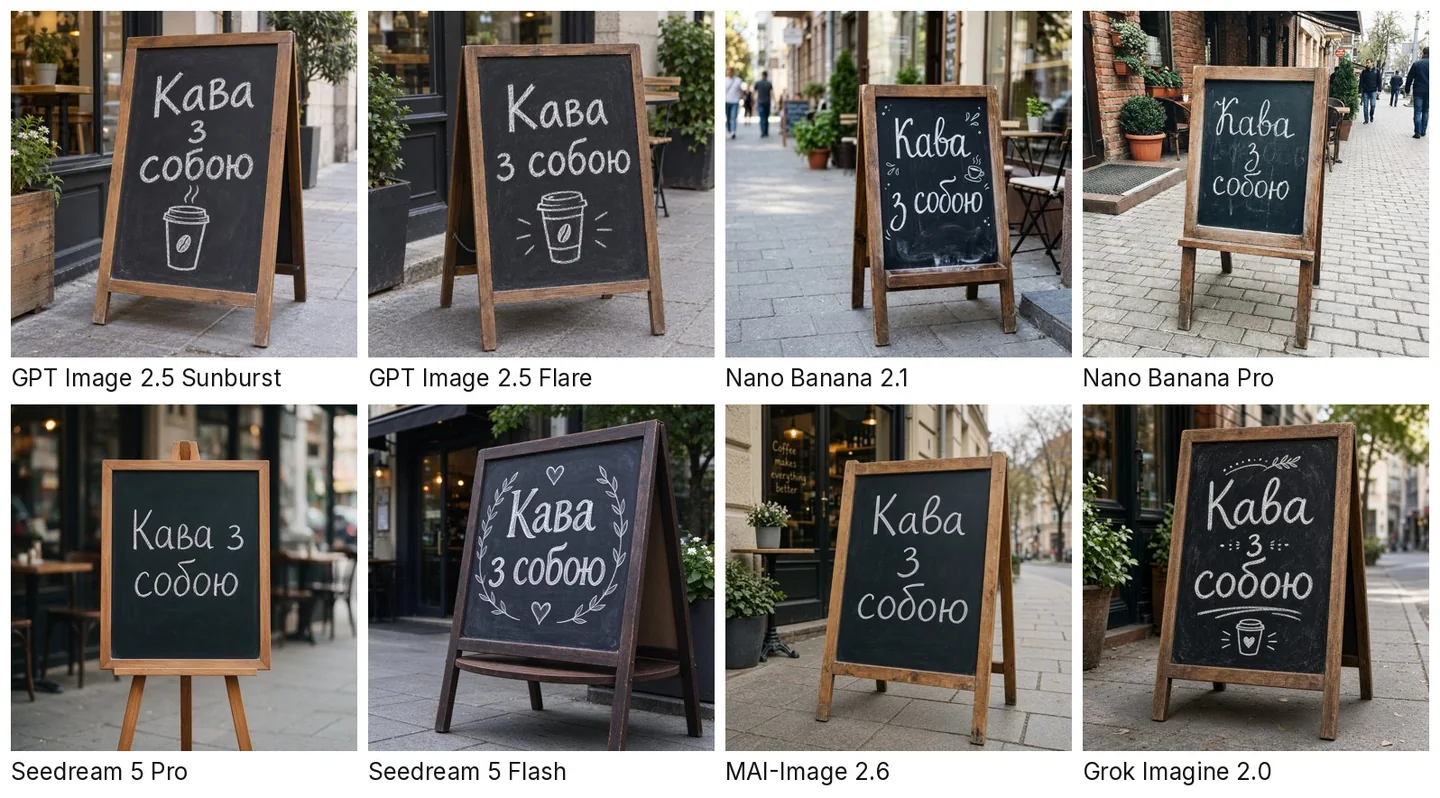
That picture is the test in miniature. On most prompts every model did everything we asked: all eight passed every check on eight of the 12, namely the Ukrainian chalkboard, fruit plate, mug and book, two children, fisherman portrait, sneaker, three-step diagram and watercolour fox. The ranking comes from the other four: the bakery sign, the night-market poster, the empty street and the piano.
| Rank | Model | Maker | Checks passed | Score |
|---|---|---|---|---|
| 1 | Grok Imagine 2.0 | xAI | 47 of 48 | 97.2% |
| 1 | Seedream 5 Flash | ByteDance | 47 of 48 | 97.2% |
| 3 | GPT Image 2.5 Sunburst | OpenAI | 45 of 48 | 93.5% |
| 3 | GPT Image 2.5 Flare | OpenAI | 45 of 48 | 93.1% |
| 3 | Seedream 5 Pro | ByteDance | 45 of 48 | 93.1% |
| 3 | Nano Banana Pro | 45 of 48 | 92.4% | |
| 7 | MAI-Image 2.6 | Microsoft | 44 of 48 | 91.7% |
| 7 | Nano Banana 2.1 | 44 of 48 | 91.4% |
We rank by checks passed, so models level on checks share a rank. The score is the share of a prompt's checks a picture passed, averaged over the 12 prompts, so every prompt counts the same however many checks it has. That is why models with the same number of checks can sit a point apart on the score: a miss on the piano prompt, with three checks, costs a third of that prompt, while a miss on the poster, with six, costs a sixth. Where the misses fell: Grok Imagine 2.0 and Seedream 5 Flash missed on the piano; GPT Image 2.5 Sunburst missed on the bakery sign, the empty street and the piano; GPT Image 2.5 Flare and Seedream 5 Pro missed on the empty street (two checks) and the piano; Nano Banana Pro missed on the empty street and the piano (two checks).
The other numbers are further down: each model's score on every ability in the comparison by ability, what we paid and the makers' list prices in the cost table, the seconds in the speed table, and every check a model failed, with the judges' notes, after the method.
The best AI image generator for each job
We name a winner only where the pictures separate the models. Where several scored the same, the table says so, and on many jobs it is a tie.
| Job | Best in our test | Score | Based on |
|---|---|---|---|
| Overall | Grok Imagine 2.0 and Seedream 5 Flash (tied) | 47 of 48 checks | all 12 prompts |
| Text in a picture | Five tied (all but GPT Image 2.5 Sunburst, MAI-Image 2.6 and Nano Banana 2.1) | 100% | 5 prompts: sign, poster, Ukrainian, sneaker, diagram |
| Non-Latin text (Ukrainian) | All eight (a tie) | 100% | 1 prompt |
| Realistic photos of people | All eight (a tie) | 100% | 1 prompt, 5 checks |
| Product shots | All eight (a tie) | 100% | 1 prompt, 4 checks |
| Diagrams and infographics | All eight (a tie) | 100% | 1 prompt, 6 checks |
| A painting style | All eight (a tie) | 100% | 1 prompt, 3 checks |
| Leaving things out | Grok Imagine 2.0 and Seedream 5 Flash (tied) | 100% | 1 prompt, 4 checks |
| Hands and instruments | Seven tied (all but Nano Banana Pro) | 66.7% | 1 prompt, 3 checks |
| Value | Seedream 5 Flash | $0.018 a picture | cheapest within one check of the most passed |
| Speed | GPT Image 2.5 Flare | 10.6 s median | 12 requests through OpenRouter |
On the three-step diagram (Write, Draw, Publish, joined by arrows), all eight passed every check. Every model passed the watercolour fox, so for a painting style it is a tie as well. For value, Seedream 5 Flash cost $0.018 a picture and passed 47 checks; GPT Image 2.5 Sunburst and Flare cost $0.013 and passed 45 checks each. For speed, GPT Image 2.5 Flare returned a picture in a median of 10.6 seconds, with Seedream 5 Flash close behind at 11.4.
Best AI image generator for realistic photos of people
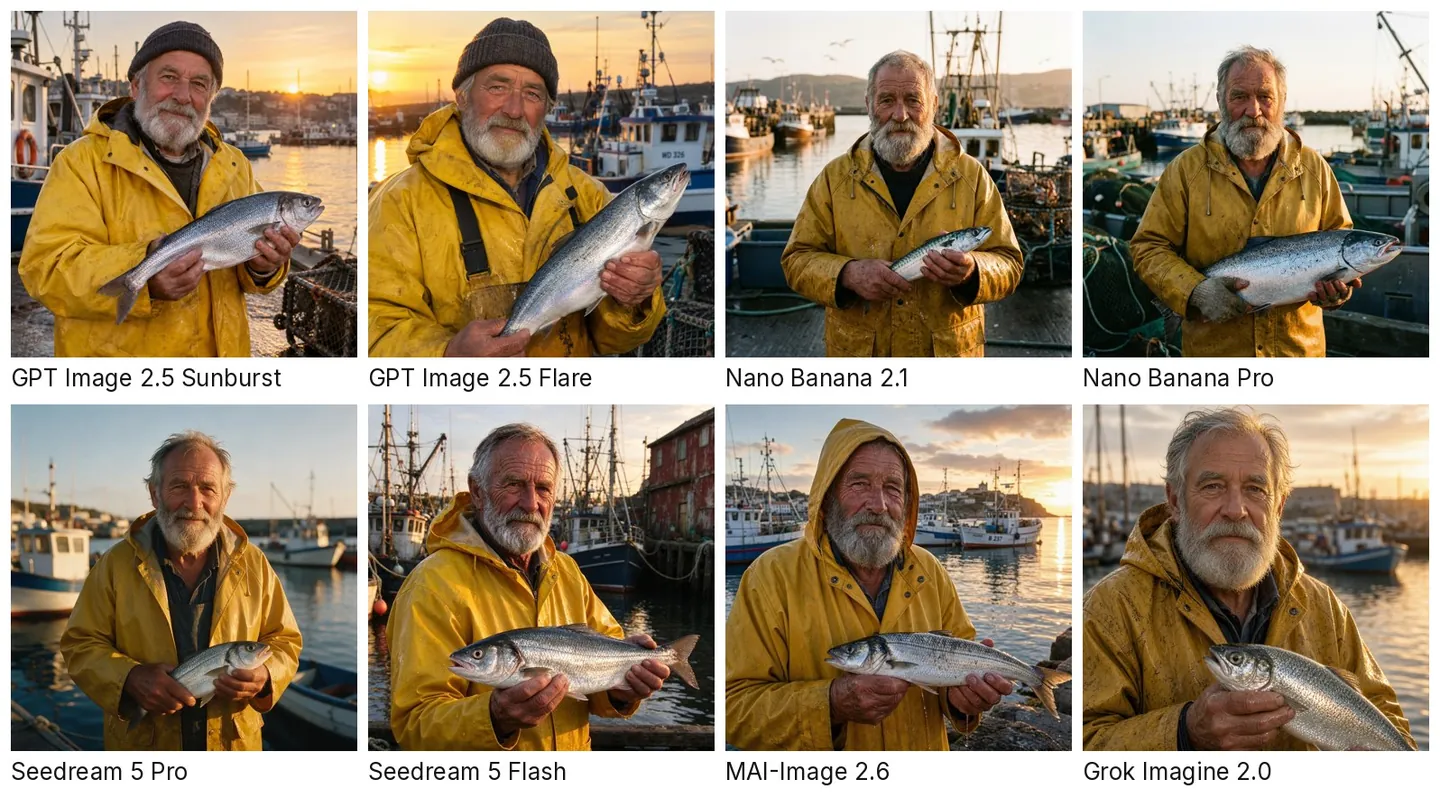
All eight passed all five checks on the fisherman portrait: an elderly man with a grey beard, a yellow raincoat, a silver fish, a harbour with boats behind him, and a photograph rather than a painting. For realistic photos of people, then, our test finds a tie. What separates these pictures is taste, not facts: compare the faces, the light and the fish below and choose the look you want. Across both photo prompts, the portrait and the sneaker, every model scored 100% on photorealism.
Best AI image generator for product photography
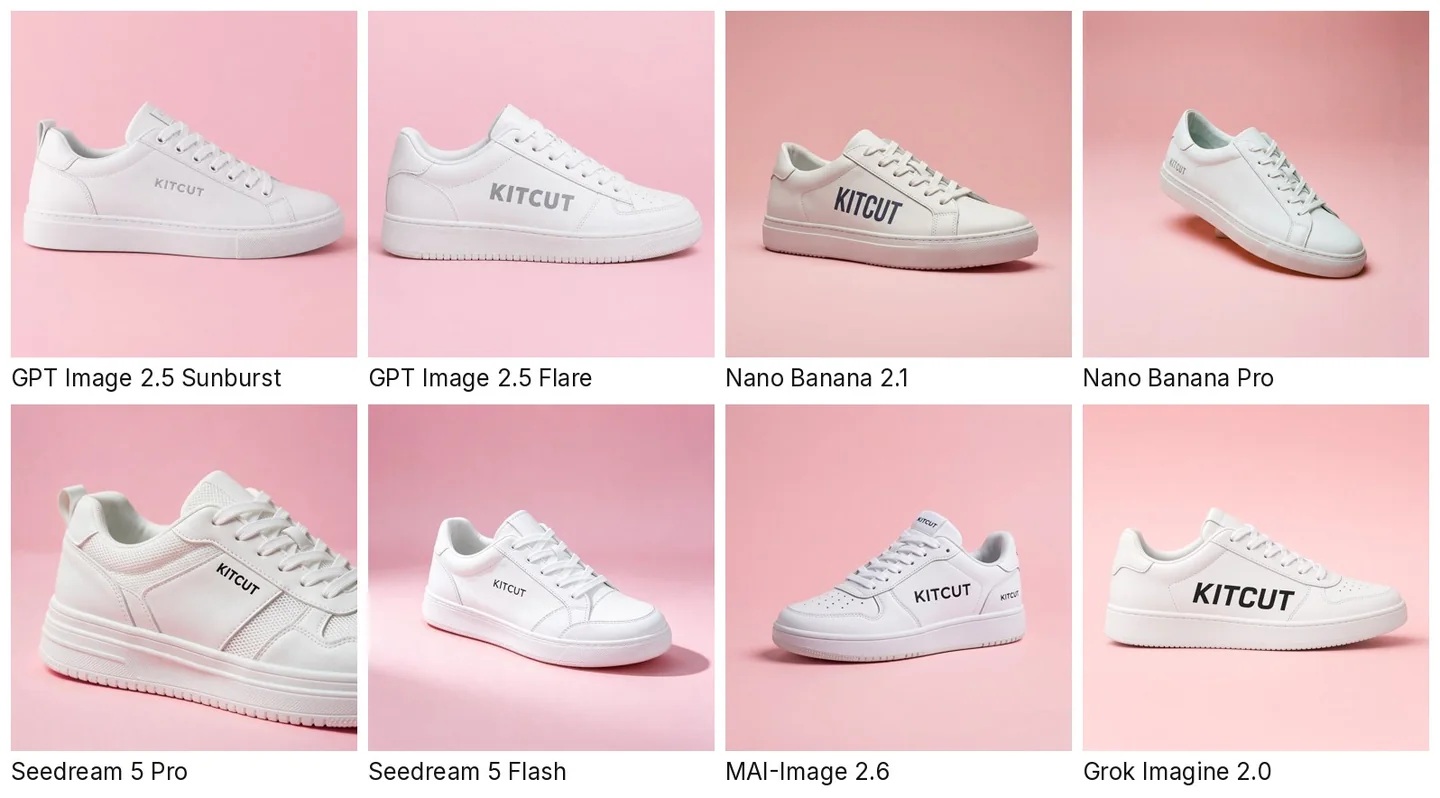
Every model printed KITCUT correctly on a white sneaker against pastel pink, so product shots are a tie too. If the name must be large and readable, look at the pictures: Nano Banana Pro printed it small near the heel, and MAI-Image 2.6 printed it three times, on the side, the tongue and the heel.
Best AI image generator with text
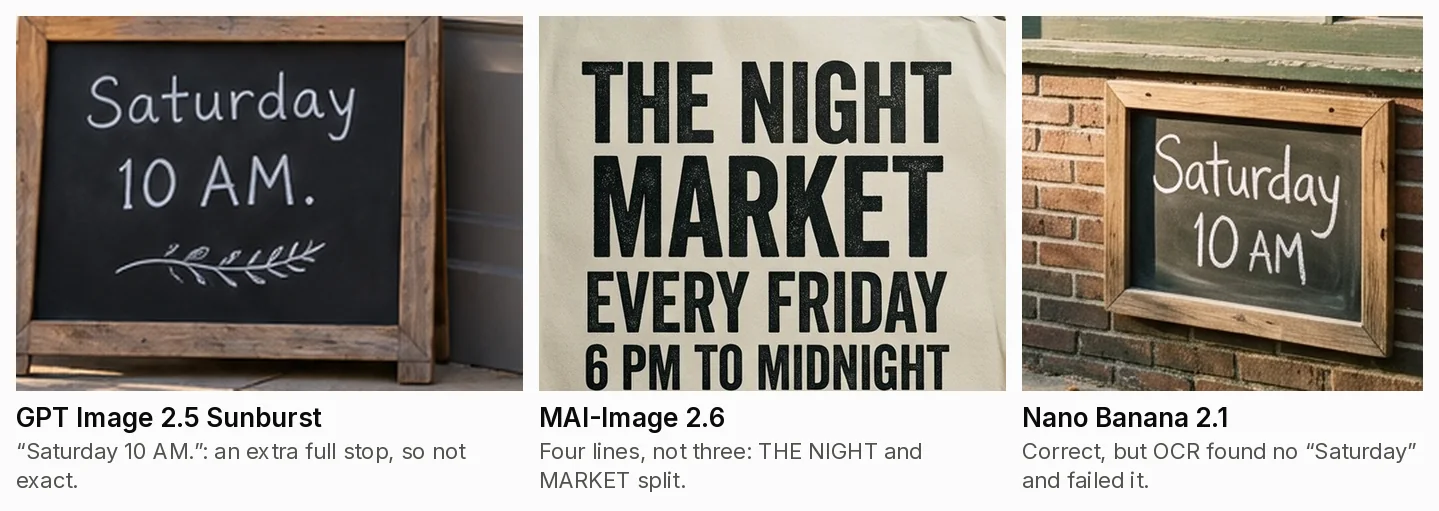
Five of the eight passed all 23 checks on the five prompts with words in them, OCR included: Grok Imagine 2.0, Seedream 5 Flash, GPT Image 2.5 Flare, Seedream 5 Pro and Nano Banana Pro. Those prompts were the bakery sign, the night-market poster, the Ukrainian chalkboard, the sneaker and the diagram. Every other model passed at least 22, and the misses were small: GPT Image 2.5 Sunburst added a full stop to “Saturday 10 AM”; MAI-Image 2.6 split the poster's first line in two; Nano Banana 2.1 lost an OCR check when the OCR found no “Saturday” on its chalkboard, which the judges read as correct.
Text in Ukrainian and other non-Latin scripts
We asked for a chalkboard reading “Кава з собою” (Ukrainian for coffee to go), because a model can spell English well and still swap Cyrillic letters for Latin look-alikes. All eight spelt it correctly, letter for letter. This prompt had no OCR check, because the OCR model we used reads Cyrillic as Latin look-alikes, so the judges checked every letter. One short phrase in one language is a small sample, so treat this as a good sign rather than a ranking.
Where AI image generators still fail
What the models still get wrong sits in three places: a piano keyboard, leaving things out, and exact words. The close-ups below are enlarged from the 1024 px originals.
Hands on a piano
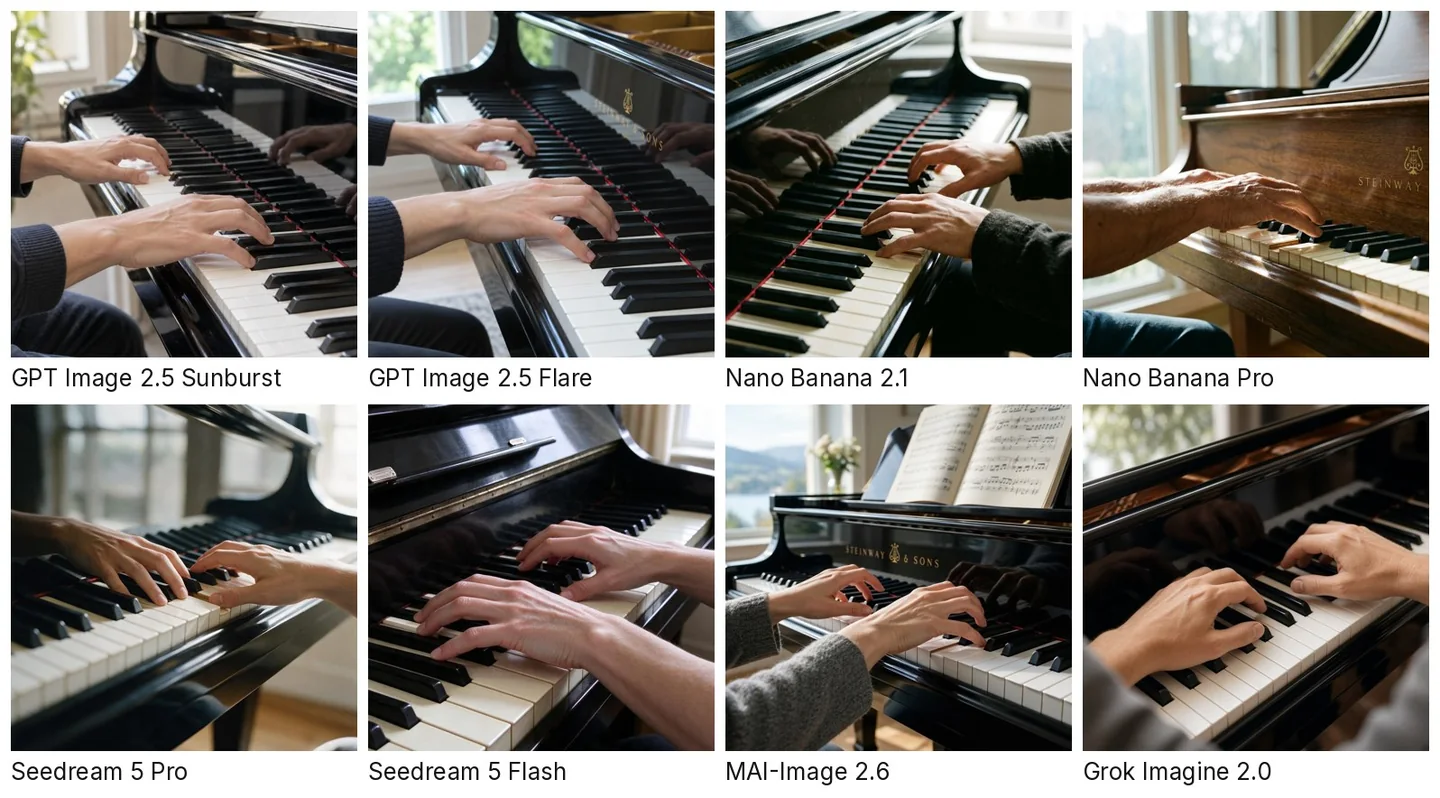
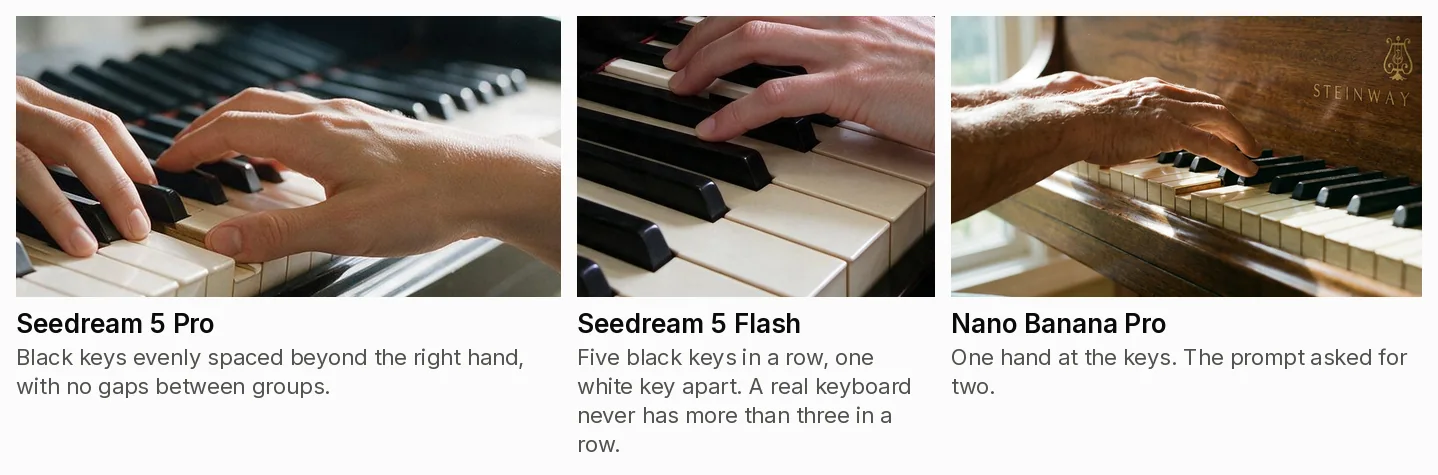
We asked for two hands playing a grand piano and checked three things: exactly two hands, five fingers on every visible hand with plausible joints, and black keys in a piano's real pattern of groups of two and three. Hands, long the classic failure of image models, came out well, with a caveat. No judge reported an extra or fused finger. But most pictures show only some of each hand's fingers, and the first two judges split on all eight: one passed them, the other failed them, mostly for fingers it could not see. A third judge, told that a finger hidden by the camera angle is not a missing finger, passed all eight. Nano Banana Pro showed only one hand. The keyboard is where every model slipped. None drew the black keys in proper groups: some put two groups of three or two pairs side by side, one left a single black key on its own, and others spaced them evenly or put four or five in a row. Most people would not notice. A pianist would, at once.
An empty street
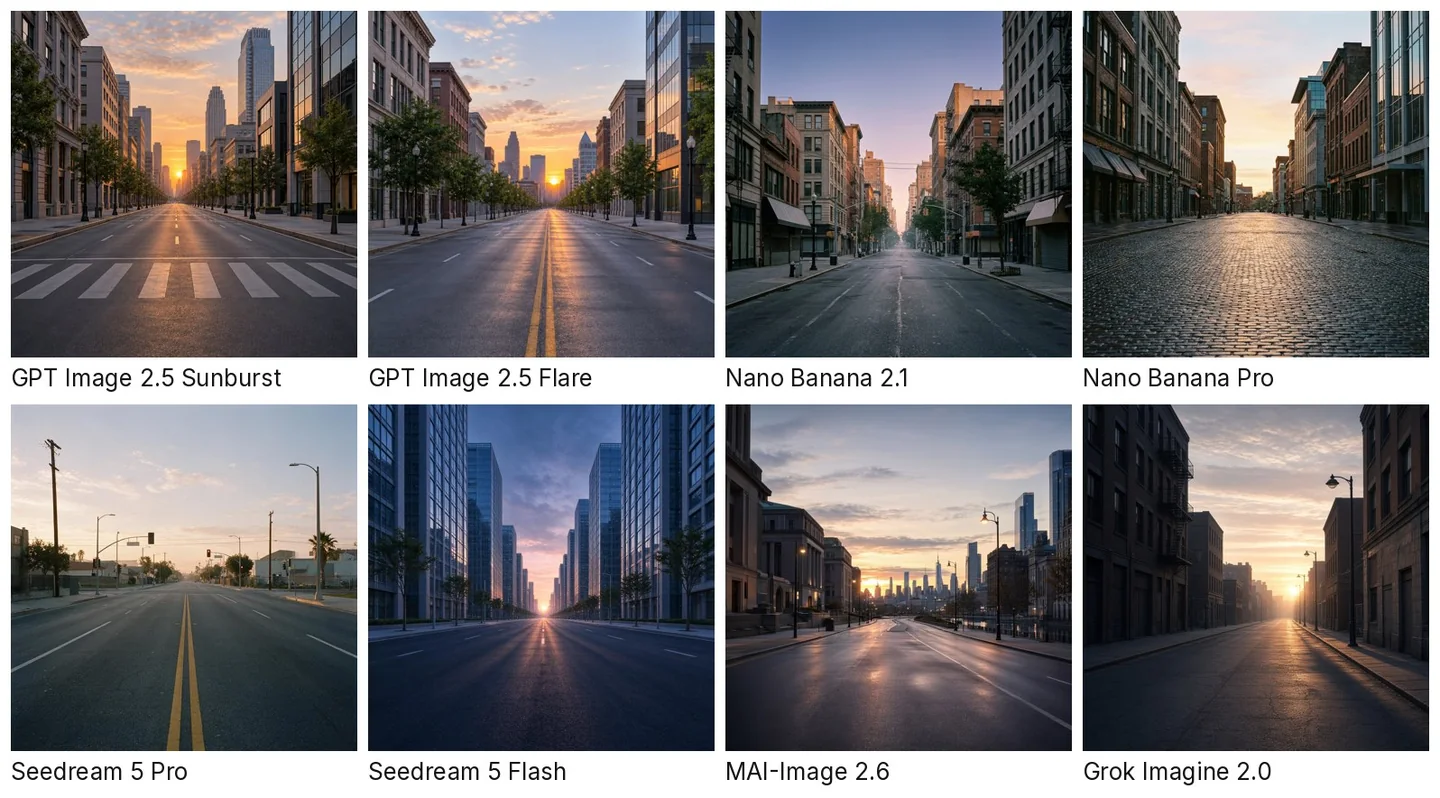
The prompt asked for an empty city street at dawn “with no people, no cars, and no signs, letters or text anywhere in the picture”. Asking for something to be absent is harder than asking for something to be there, and most models put something back: five drew a car or another vehicle and five a sign. Only Grok Imagine 2.0 and Seedream 5 Flash left out everything. OCR found no lettering in any of the eight pictures, so the misses are objects, not words. Most are small, at the far end of the road or high on a pole, which is why the check matters: they show when a picture is printed large or cropped.
Exact words
Text was the strongest area, and the misses that remain are small. Two are real: an extra full stop on GPT Image 2.5 Sunburst's chalkboard, which the word “exactly” in the prompt rules out, and a four-line title on MAI-Image 2.6's poster. The third is the OCR's: it found no “Saturday” on Nano Banana 2.1's chalkboard, which both judges read as correct.
AI image generator comparison by ability
The heatmap puts the abilities side by side. Counting, binding, photorealism and style are 100% for every model, text and layout dip in places, and exclusion and anatomy are where the models differ most.
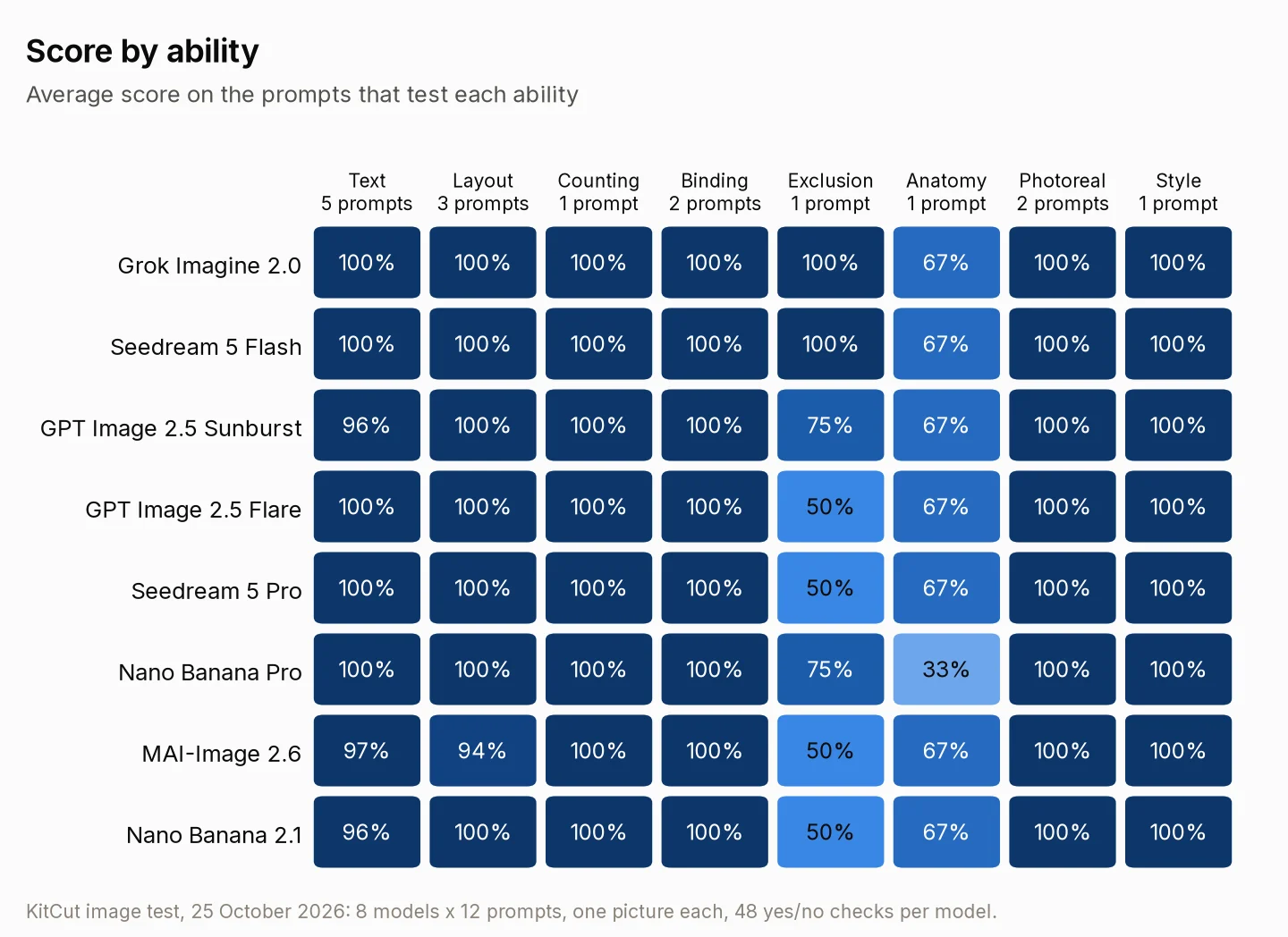
| Model | Text | Layout | Counting | Binding | Exclusion | Anatomy | Photoreal | Style |
|---|---|---|---|---|---|---|---|---|
| Grok Imagine 2.0 | 100% | 100% | 100% | 100% | 100% | 67% | 100% | 100% |
| Seedream 5 Flash | 100% | 100% | 100% | 100% | 100% | 67% | 100% | 100% |
| GPT Image 2.5 Sunburst | 96% | 100% | 100% | 100% | 75% | 67% | 100% | 100% |
| GPT Image 2.5 Flare | 100% | 100% | 100% | 100% | 50% | 67% | 100% | 100% |
| Seedream 5 Pro | 100% | 100% | 100% | 100% | 50% | 67% | 100% | 100% |
| Nano Banana Pro | 100% | 100% | 100% | 100% | 75% | 33% | 100% | 100% |
| MAI-Image 2.6 | 97% | 94% | 100% | 100% | 50% | 67% | 100% | 100% |
| Nano Banana 2.1 | 96% | 100% | 100% | 100% | 50% | 67% | 100% | 100% |
How much does each AI image generator cost?
Per picture at 1K, what we paid ran from $0.013 (GPT Image 2.5 Sunburst and Flare at medium quality) to $0.134 (Nano Banana Pro): $13 against $134 per 1,000 pictures. OpenRouter passed on the makers' list prices: where a maker publishes a price for a picture at our settings, we paid within 0.3 cents of it. Microsoft publishes no price for MAI-Image 2.6. Nano Banana Pro, the dearest at $0.134, passed 45 checks, the same as GPT Image 2.5 Sunburst and Flare, the cheapest at $0.013. Seedream 5 Flash, at $0.018, shares the top score with Grok Imagine 2.0, which cost more than three times as much. In this test, paying more did not buy a higher score.
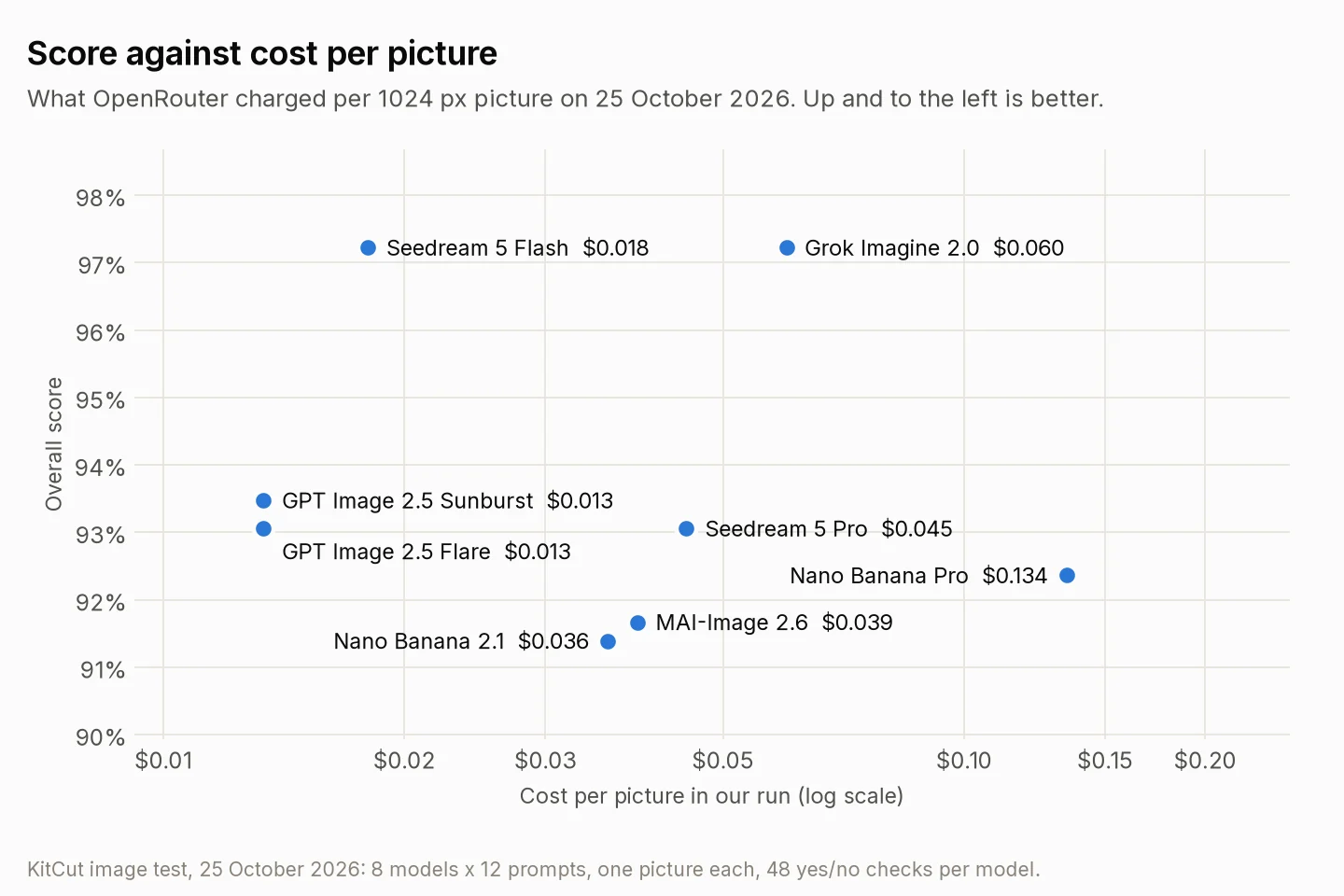
| Model | Score | Our cost per picture | Per 1,000 pictures | List price (maker) |
|---|---|---|---|---|
| GPT Image 2.5 Sunburst | 93.5% | $0.013 | $13 | $0.013 at medium |
| GPT Image 2.5 Flare | 93.1% | $0.013 | $13 | $0.013 at medium |
| Seedream 5 Flash | 97.2% | $0.018 | $18 | $0.018 |
| Nano Banana 2.1 | 91.4% | $0.036 | $36 | $0.0336 |
| MAI-Image 2.6 | 91.7% | $0.039 | $39 | None published |
| Seedream 5 Pro | 93.1% | $0.045 | $45 | $0.045 |
| Grok Imagine 2.0 | 97.2% | $0.060 | $60 | $0.06 at medium ($0.04 at low) |
| Nano Banana Pro | 92.4% | $0.134 | $134 | $0.134 |
A quality setting moves the price a long way. OpenAI charges $30 per million image tokens for GPT Image 2.5, which its calculator turns into $0.006 a picture at low quality, $0.013 at medium, $0.053 at high, $0.094 at xhigh and $0.211 at max; we tested medium. xAI lists Grok Imagine 2.0 at $0.04 a picture at low quality and $0.06 at the medium quality we asked for. If you are choosing for video rather than stills, our AI video generator pricing compares cost per second, model by model, and we have run one open video model, MiniMax H3, on an 8 GB graphics card.
Which AI image generator is fastest?
GPT Image 2.5 Flare was the fastest, at a median of 10.6 seconds from request to finished picture, with Seedream 5 Flash close behind at 11.4. Grok Imagine 2.0 was the slowest at 54.4 seconds, about five times as long. These are times through OpenRouter on one day, so the provider's queue is in them.
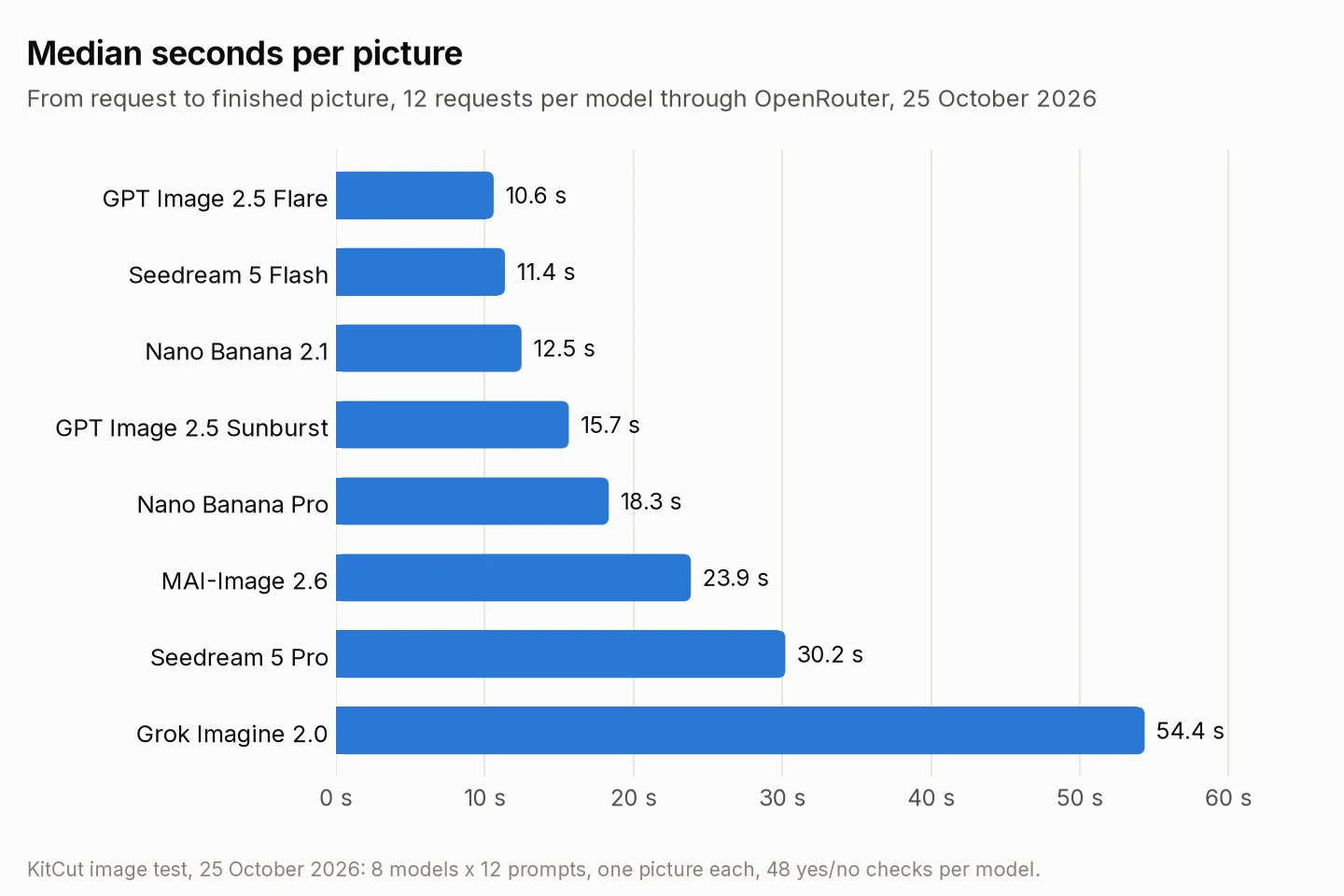
| Model | Median | Fastest | Slowest |
|---|---|---|---|
| GPT Image 2.5 Flare | 10.6 s | 8.3 s | 16.1 s |
| Seedream 5 Flash | 11.4 s | 10.1 s | 17.0 s |
| Nano Banana 2.1 | 12.5 s | 10.3 s | 14.5 s |
| GPT Image 2.5 Sunburst | 15.7 s | 11.3 s | 18.1 s |
| Nano Banana Pro | 18.3 s | 15.8 s | 20.4 s |
| MAI-Image 2.6 | 23.9 s | 22.8 s | 25.5 s |
| Seedream 5 Pro | 30.2 s | 20.1 s | 48.3 s |
| Grok Imagine 2.0 | 54.4 s | 45.2 s | 65.8 s |
Where can you use these models?
We tested the models through their APIs. Most of them also work in an app, and the table shows where, according to each maker's own pages on 25 October 2026. An app may use other settings than we did, so its pictures will not always match ours.
| Model | Where you can use it | What the maker says |
|---|---|---|
| GPT Image 2.5 Sunburst and Flare | ChatGPT (as ChatGPT Images 2.5), Codex and the OpenAI API | OpenAI's system card for ChatGPT Images 2.5 covers both models and names ChatGPT, Codex and the OpenAI API as the places where their pictures are watermarked. It does not say which of the two ChatGPT uses. |
| Nano Banana 2.1 | The Gemini app with a Google AI Plus, Pro or Ultra plan; AI Mode in Google Search | Free Gemini users get Nano Banana 2 (Gemini image generation). In AI Mode it is available in English to users over 18 in the US, and to Google AI Pro and Ultra subscribers (Google Search Help). |
| Nano Banana Pro | The Gemini app, on a paid plan | Paid users “can regenerate images using Nano Banana Pro by selecting the three dot menu and then ‘Redo with Pro’” (Gemini image generation). |
| Seedream 5 Pro | CapCut and Dreamina | “Dola Seedream 5.0 Pro is available now for paying CapCut subscribers in Europe, Asia, the Middle East, South America and the United States” (CapCut, 31 July 2026). Dreamina offers it as “Image 5.0 Pro by Seedream 5.0 Pro”. |
| Seedream 5 Flash | We found no app on ByteDance's pages | We could only confirm it through the API. |
| MAI-Image 2.6 | MAI Playground; Microsoft Foundry for developers | Microsoft's model card lists these two, under Foundry's earlier name, Azure AI Foundry. MAI Playground calls itself “a limited preview of new and experimental AI models”. We found no Microsoft page that puts the model in Copilot or Bing Image Creator. |
| Grok Imagine 2.0 | Grok, on grok.com and in its iOS and Android apps | “Imagine Image 2.0 is now generally available as the new Quality Mode on grok.com/imagine, and our iOS and Android apps” (xAI, 7 August 2026). The post names no plans. |
AI image generators we could not test, and why
Some well-known models are missing from our table. The prices and positions below are not our measurements: they are the makers' list prices and two public arenas, where people vote for the picture they prefer.
| Model | Why it is not in our test | List price per picture | Arena position (third-party) |
|---|---|---|---|
| Midjourney V8.2 | No public API, and its terms ban automated access | Subscription only | Not listed by Artificial Analysis |
| FLUX 3 Image / Klein (Black Forest Labs) | Our API account's provider settings blocked it | $0.048 / $0.009 at 1K | 13th and 21st on Artificial Analysis; not in LMArena's top 10 |
| Qwen-Image 2.1 Pro / Turbo (Alibaba) | Blocked the same way | $0.04 / $0.016 (international) | 19th and 27th on Artificial Analysis; not in LMArena's top 10 |
| Recraft V4.1 / Pro / Flash | Blocked the same way | $0.035 / $0.21 (2K) / $0.007 | Best Recraft entry 29th on Artificial Analysis; not in LMArena's top 10 |
| Krea 3 Fast / High / Ultra | Blocked the same way | $0.03 / $0.05 / $0.28 (2K, with the input image Ultra needs) | Krea 3 Ultra, for image editing: 4th on Artificial Analysis, 8th on LMArena |
| Ideogram 4.5 | Not sold through the API we used | $0.03 / $0.06 / $0.10 at low / medium / high, on Replicate | 40th on Artificial Analysis; not in LMArena's top 10 |
| GPT Image 2 (OpenAI) | Not in this round | $0.053 at medium | 3rd on both |
| Muse Image (Meta) | Not in this round | $0.01 | 8th on Artificial Analysis, 9th on LMArena |
Midjourney publishes no API, and its terms of service say: “You may not use automated tools to access, interact with, or generate Assets through the Services.” Our test is automated from end to end, so Midjourney can only be compared by hand, and we have not done that. FLUX 3, Qwen-Image, Recraft and Krea are sold through the same API we used, but our account's provider settings refused to route to them on 25 October. The arena positions are from Artificial Analysis's text-to-image arena, read on 25 October, and from LMArena's published data (text-to-image as of 7 October and image editing as of 20 October, its latest snapshots).
Planned for the next round: FLUX 3, Qwen-Image, Recraft and Krea, Ideogram through its own API, GPT Image 2 and Muse Image. We also plan to put people in nearly every prompt: portraits, hands, two people the model has to tell apart, a person holding a sign, and the same person across several scenes. Four harder prompts are planned too: a clock showing 4:35, a wine glass full to the brim, a five-line menu with prices, and eleven ducks.
How our results compare with the arenas
Arenas and checklists answer different questions. An arena asks people which of two pictures they prefer; our test asks whether a picture contains what the prompt asked for. Both arenas put OpenAI's two models first and second; Artificial Analysis tests them at max quality, we tested medium. In our test they passed 45 checks each, against 47 for the leaders. Seedream 5 Flash, which shares first place in our test, is not rated on either arena. Neither ranking is wrong: one measures which picture people like, the other whether the picture does what it was asked.
| Model | Our rank | Artificial Analysis | LMArena |
|---|---|---|---|
| Grok Imagine 2.0 | 1 | 6 | 4 (a “canvas” version) and 8 |
| Seedream 5 Flash | 1 | Not rated | Not rated |
| GPT Image 2.5 Sunburst | 3 | 1 (at max quality) | 1 |
| GPT Image 2.5 Flare | 3 | 2 (at max quality) | 2 |
| Seedream 5 Pro | 3 | 16 | 12 |
| Nano Banana Pro | 3 | 11 | 16 |
| MAI-Image 2.6 | 7 | 5 | 5 |
| Nano Banana 2.1 | 7 | 4 | 6 |
That is also why we run our own test rather than copy numbers from a leaderboard. We traced where the scores on two big language-model leaderboards come from, and neither site ran the tests.
How we tested
- 12 prompts with facts that can be checked. Each comes with two to six yes/no checks, and each check names the ability it measures: text, layout, counting, binding, exclusion, anatomy, photorealism or style. 38 checks per model are questions for a judge and 10 are read by OCR, 48 in all.
- One picture per model per prompt. Square, 1024 by 1024, at the 1K setting, with quality set to medium on the models that have a quality setting (GPT Image 2.5 Sunburst, GPT Image 2.5 Flare and Grok Imagine 2.0). Nothing else was tuned. We made all 96 pictures through OpenRouter's image API on 25 October 2026, in about six minutes, for $4.31.
- Judged blind. For each prompt the pictures were shuffled and given letters, so the judges never knew which model made which. We checked afterwards that each of the 96 letters points at the right picture.
- Two judges, then a third. Two separate Claude Opus 5.5 judges answered every check yes or no under written rules: yes only when the picture clearly satisfies the question; no when it fails, is ambiguous or cannot be told; spelling exact. Their answers to the same questions agreed 95.7% of the time, across 304 pairs (Cohen's kappa 0.72). A third judge settled the 13 on which they differed. It had the same rules plus one line for the fingers question: a finger hidden by the camera angle is not a missing finger. Eight of the 13 were that question, one for each piano picture, and it passed all eight. We have not yet checked the judges against people: two runs of the same model agreeing shows they are consistent, not that they are right, which is one reason we treat a gap of one or two checks as noise.
- OCR on the words. RapidOCR read every picture. Its text check ignores spaces, because RapidOCR runs words together (“EVERYFRIDAY”, “10AM”) even where the lettering has them: under a strict rule, 10 of its 11 misses were only a missing space. Its answers count alongside the judges'. Where both read the same words, OCR and the judges agreed on 22 of 24.
- The rank and the score. Models are ranked by checks passed, so models level on checks share a rank. The score is the share of checks passed on each prompt, averaged over the 12 prompts.
The 12 prompts, exactly as the models received them:
| # | Prompt | Tests | Checks |
|---|---|---|---|
| 1 | A photo of a small bakery storefront in the morning. Above the door, a wooden sign reads exactly: GRAND OPENING. Below the window, a small chalkboard reads exactly: Saturday 10 AM. | text | 5 (2 OCR) |
| 2 | A minimalist poster pasted on a brick wall. Three lines of large bold text, one under another: THE NIGHT MARKET / EVERY FRIDAY / 6 PM TO MIDNIGHT. A small paper lantern illustration under the text. | text, layout | 6 (3 OCR) |
| 3 | A cafe chalkboard sign on an easel on a sidewalk. Written in white chalk, the Ukrainian words: Кава з собою | text | 2 |
| 4 | Top-down photo of a white plate on a wooden table with exactly four red apples and exactly two green pears on it, and nothing else on the plate. | counting | 3 |
| 5 | On a wooden desk: a blue mug on the left, a yellow book on the right, and a black pen lying on top of the yellow book. Plain wall behind. | layout | 3 |
| 6 | A girl in a red coat holding a green umbrella stands next to a boy in a yellow raincoat holding a blue umbrella, on a rainy street. | binding | 4 |
| 7 | An empty city street at dawn with no people, no cars, and no signs, letters or text anywhere in the picture. | exclusion | 4 (1 OCR) |
| 8 | Close-up photo of two hands playing a grand piano, natural daylight. | anatomy | 3 |
| 9 | Photorealistic portrait of an elderly fisherman with a grey beard, wearing a yellow raincoat, holding a silver fish, a harbor with boats behind him, golden hour light. | binding, photoreal | 5 |
| 10 | Product photo of a white sneaker with the word KITCUT printed on its side, on a pastel pink background, soft studio lighting. | text, photoreal | 4 (1 OCR) |
| 11 | A clean flat infographic on a white background: three labelled steps in a row from left to right, Write, Draw, Publish, connected by arrows. | text, layout | 6 (3 OCR) |
| 12 | A watercolor painting of a red fox sitting in a snowy forest, visible paper texture and soft washes. | style | 3 |
Anthropic, which makes Claude, sells no image model, so the judge has no house favourite. The full method, with the prompts, the judging rules and how to run it yourself, is in how we test AI image generators. Two of the models, OpenAI's Sunburst and Flare, are compared picture by picture in GPT Image 2.5 Sunburst vs Flare.
Every check a model failed
All 22 failed checks, with the judges' notes. Everything not listed here passed.
| Model | Prompt | Check it failed | Note |
|---|---|---|---|
| Grok Imagine 2.0 | Hands on a piano | Do the piano keys look regular (black keys in groups of two and three, no melted keys)? | one black key stands alone between unbroken white-key boundaries (groups 2,1,2,3) |
| Seedream 5 Flash | Hands on a piano | Do the piano keys look regular (black keys in groups of two and three, no melted keys)? | five black keys in a row, each one white key apart |
| GPT Image 2.5 Sunburst | Bakery sign | Is there a small chalkboard whose text is exactly 'Saturday 10 AM'? | Board reads 'Saturday 10 AM.' with an extra trailing period; not exact. |
| GPT Image 2.5 Sunburst | Empty street | Is the picture free of any cars or vehicles? | row of vehicle-shaped blobs across the far end of the avenue |
| GPT Image 2.5 Sunburst | Hands on a piano | Do the piano keys look regular (black keys in groups of two and three, no melted keys)? | two groups of three black keys in a row near the hands |
| GPT Image 2.5 Flare | Empty street | Is the picture free of any cars or vehicles? | car with red tail lights at the far end of the road |
| GPT Image 2.5 Flare | Empty street | Is the picture free of any signs, letters or text? | white banner with a mark on a lamppost, left |
| GPT Image 2.5 Flare | Hands on a piano | Do the piano keys look regular (black keys in groups of two and three, no melted keys)? | Under the lower hand's fingertips: a group of three, then two pairs in a row, each bounded by white gaps. Pattern broken. |
| Seedream 5 Pro | Empty street | Is the picture free of any cars or vehicles? | 2 cars parked behind the fence on the right |
| Seedream 5 Pro | Empty street | Is the picture free of any signs, letters or text? | blank street-name sign plates on signal arms; small sign on building |
| Seedream 5 Pro | Hands on a piano | Do the piano keys look regular (black keys in groups of two and three, no melted keys)? | six black keys beyond the right hand evenly spaced, no group gaps |
| Nano Banana Pro | Empty street | Is the picture free of any signs, letters or text? | blue plate on lamppost, blank oval hanging sign, blank shop sign board |
| Nano Banana Pro | Hands on a piano | Are there exactly two hands? | 1 hand clearly visible; a second is at most a vague shape behind the wrist |
| Nano Banana Pro | Hands on a piano | Do the piano keys look regular (black keys in groups of two and three, no melted keys)? | four black keys in a row before the next gap |
| MAI-Image 2.6 | Night-market poster | Are there exactly three lines of headline text, in the order THE NIGHT MARKET, EVERY FRIDAY, 6 PM TO MIDNIGHT, all spelled correctly? | 4 lines: 'THE NIGHT' and 'MARKET' split onto separate lines; spelling correct. |
| MAI-Image 2.6 | Empty street | Is the picture free of any cars or vehicles? | dark car-like shape on the waterfront promenade, right |
| MAI-Image 2.6 | Empty street | Is the picture free of any signs, letters or text? | lit vertical banners with letter-like glyphs on left building |
| MAI-Image 2.6 | Hands on a piano | Do the piano keys look regular (black keys in groups of two and three, no melted keys)? | left end: long white run then evenly spaced black keys, no 2/3 grouping |
| Nano Banana 2.1 | Bakery sign | OCR finds "Saturday 10 AM" | OCR read: "GRAND OPENING 10 AM" |
| Nano Banana 2.1 | Empty street | Is the picture free of any cars or vehicles? | bicycle locked to a pole on right sidewalk; distant vehicle light |
| Nano Banana 2.1 | Empty street | Is the picture free of any signs, letters or text? | street-name blade sign on pole; white sign panel on a post |
| Nano Banana 2.1 | Hands on a piano | Do the piano keys look regular (black keys in groups of two and three, no melted keys)? | Rectified along the felt: two groups of three black keys in a row, under the fingertips of both hands. Pattern broken. |
Limits
- 12 prompts, one picture each. A second try at the same prompt can come out differently, and an ability tested by one prompt rests on three or four checks. A difference of one or two checks is within what a re-run could change.
- One setting, one route, one day. We tested 1K at medium quality through one API on 25 October 2026. Higher quality settings, a maker's own app or a later version can do better or worse.
- The judges are AI models. They were cross-checked against each other and against OCR, not against people.
- OCR can miss a word. Our OCR checks ignore spaces, because RapidOCR runs words together (“EVERYFRIDAY”) even where the lettering has them. It still missed one word the judges read as correct, “Saturday” on Nano Banana 2.1's chalkboard, and the method counts the OCR's answer, so that miss stands.
- Seconds are a rough guide. They are wall-clock times through OpenRouter, queueing included.
KitCut makes films with image models: collage pictures and characters drawn for explainers. We ran this test to choose which model draws what. We graded language models the same way, blind, on our own films, in the cheaper model wasn't half the price.
FAQ
What is the best AI image generator in 2026?
Seedream 5 Flash and Grok Imagine 2.0 tied for first in our test of eight models on 12 prompts, each passing 47 of 48 checks (97.2%). Seedream 5 Flash is the better buy of the two: $0.018 a picture and 11.4 seconds, against $0.060 and 54.4 seconds. Four more models passed 45, two checks fewer, a gap a re-run could close; they include GPT Image 2.5 Sunburst and Flare, the cheapest at $0.013.
Which AI image generator is best for text in images?
In our test, Grok Imagine 2.0, Seedream 5 Flash, GPT Image 2.5 Flare, Seedream 5 Pro and Nano Banana Pro passed all 23 checks on the five prompts with words in them, including a phrase in Ukrainian. All eight spelt the main words correctly; the misses were an extra full stop, a title split over two lines and one word the OCR could not read.
What is the cheapest good AI image generator?
In our run, GPT Image 2.5 Sunburst and Flare cost $0.013 a picture at medium quality and passed 45 of 48 checks each. Seedream 5 Flash cost $0.018 and shares the top score. Nano Banana Pro cost $0.134, about 10 times as much, and passed the same 45 checks as GPT Image 2.5.
Can AI image generators draw hands now?
Mostly. In our piano prompt, no judge reported an extra or fused finger, and all eight passed the fingers check once a finger hidden by the camera angle counted as hidden, not missing. Nano Banana Pro showed one hand instead of two. The keyboard under them is harder still: none of the eight drew the black keys in proper groups of two and three.
Why is Midjourney not in the test?
Midjourney has no public API, and its terms of service ban automated access, so it cannot run in an automated test like ours. It is also not listed on Artificial Analysis's text-to-image leaderboard. We would need to test it by hand in its app, which we have not done.
How were the pictures scored?
Each prompt has two to six yes/no checks, 48 per model in all. Two Claude judges answered every check blind, a third settled disagreements, and OCR read the words. We rank models by checks passed, and treat a gap of one or two checks as noise, because the judges have not yet been checked against people. The score is the share of checks passed on each prompt, averaged over the 12 prompts.