 KitCut
GPT Image 2.5 Sunburst vs Flare: the same 12 prompts, side by side
GPT Image 2.5 comes in two versions, Sunburst and Flare, at the same price: $30 per million image output tokens, about $0.013 for a 1024×1024 picture at medium quality. OpenAI pitches Sunburst “for workflows where editing precision matters most” and Flare “for fast, high-quality everyday image generation”, and our tests agree. On the same 12 prompts Flare was faster every time (median 10.6 seconds against 15.7), and our blind checks barely told them apart: both passed 45 of 48. Sunburst held steadier when edited, on the one character we tested. Use Sunburst for edits and recurring characters, Flare for most new pictures.
Updated 25 October 2026, with prices and arena standings as published that day.
At a glance
- The same price. $30 per million image output tokens for both: $0.006 a 1024×1024 picture at low quality, $0.013 at medium, $0.211 at max. Ours were billed identically, prompt by prompt.
- Flare is faster. Median 10.6 seconds a picture against 15.7 at medium quality, and faster on all 12 prompts; at max, Artificial Analysis measures 53.1 seconds against 115.3.
- Our checks barely separate them. Both passed 45 of 48 checks, differing on two: too close for 12 pictures to settle.
- Arena voters lean towards Sunburst: 15 Elo points ahead of Flare in Artificial Analysis’s text-to-image arena and 17 in editing, at max quality.
- Sunburst held steadier under edits on the one character we tested: told to change only the face, it changed 0.4–1.8% of the rest of the figure; Flare changed 0.9–3.5%.
- We use Flare for cut-outs: 17 on a transparent background for $0.197. Sunburst’s transparent edits came back with a cloudy halo about half the time, so we edit on white.
Which to use
- Editing a picture, or keeping a character the same: Sunburst. It is OpenAI’s pick for editing, leads the editing arena and drifted less on the one character we tested.
- Speed, or a lot of pictures: Flare. The same price per picture, and faster on all 12 of our prompts. To spend less, change the quality setting, not the version.
- Cut-outs on a transparent background: Flare, in our experience. For transparent edits, ask for white: about half of Sunburst’s came back with a halo.
The reasons, and the other cases, are under which should you use.
What is the difference between GPT Image 2.5 Sunburst and Flare?
They are two versions of GPT Image 2.5, released together: both current snapshots are dated 8 September 2026. OpenAI calls Sunburst “Our most capable model for image generation and editing” and Flare “Fast, high-quality everyday image generation”. Everything else is shared: the endpoints (generation, edits, the Batch API and the Responses API’s image tool), the quality settings, transparent backgrounds, prices and rate limits. The choice comes down to speed, looks and how steady an edit is.
| Sunburst | Flare | |
|---|---|---|
| Model ID | gpt-image-2.5-sunburst | gpt-image-2.5-flare |
| OpenAI’s one-line description | “Our most capable model for image generation and editing” | “Fast, high-quality everyday image generation” |
| Current snapshot | 8 September 2026 | 8 September 2026 |
| Quality settings | low, medium, high, xhigh, max, auto | low, medium, high, xhigh, max, auto |
| Transparent background | yes | yes |
| Reference pictures (OpenRouter) | up to 16 | up to 16 |
| Rate limit, Build tier | 20 pictures a minute | 20 pictures a minute |
In Artificial Analysis’s blind arenas at max quality, Sunburst leads Flare 1222 to 1207 for text to image and 1199 to 1182 for editing. The leads are small, but Artificial Analysis’s own range of plausible ranks puts Sunburst first and Flare second on both boards. Both are ahead of every other model: the next scores are 1186 for text to image (GPT Image 2, high) and 1151 for editing (a three-way tie between MAI-Image-2.6, Krea 3 Ultra and Nano Banana 2.1).
GPT Image 2.5 pricing: what does a picture cost?
Both versions bill by the token at the same rates: $30 per million image output tokens and $8 per million image input tokens, for any picture you send in. Choosing one over the other does not change the price; the quality setting and the size do. The calculator in OpenAI’s image generation guide uses one token table for both; for a 1024×1024 picture it gives:
| Quality | Output tokens | Price a picture | With the Batch API |
|---|---|---|---|
| low | 196 | $0.0059 | $0.0029 |
| medium | 439 | $0.0132 | $0.0066 |
| high | 1,756 | $0.0527 | $0.0263 |
| xhigh | 3,122 | $0.0937 | $0.0468 |
| max | 7,024 | $0.2107 | $0.1054 |
Prompt text adds $5 per million tokens, a few hundredths of a cent here, and the Batch API halves every price (OpenAI’s pricing page). Our 24 pictures at medium cost $0.0133 to $0.0134 each, the same for both versions on every prompt. OpenAI’s guide warns that “equal token rates don’t mean equal cost per image: token consumption can differ by model and quality setting.” At medium we saw no difference; we did not test other settings. Artificial Analysis lists both at $210.72 per 1,000 pictures at max, as the calculator does. Video is priced per second: see AI video generator pricing.
Sunburst vs Flare: the same 12 prompts, side by side
Each prompt went once to each model, at medium quality and 1024×1024, with no retries and no picking. Each caption gives the prompt and the judges’ verdict; the paragraph under it is what we noticed ourselves, and is not scored. Sunburst is always on the left.
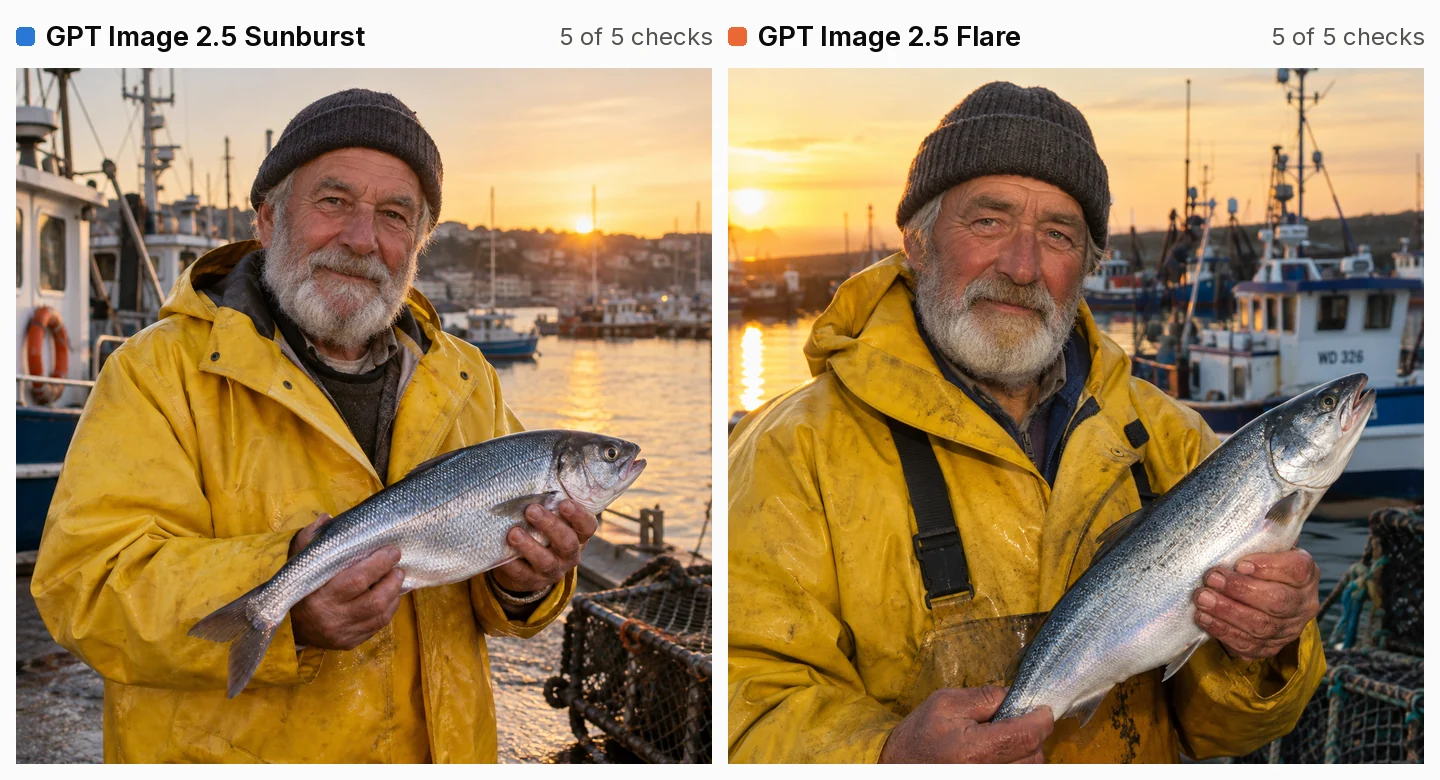
1. A photo portrait: the fisherman
The full pair is at the top of this page. Here are the faces and hands, enlarged.
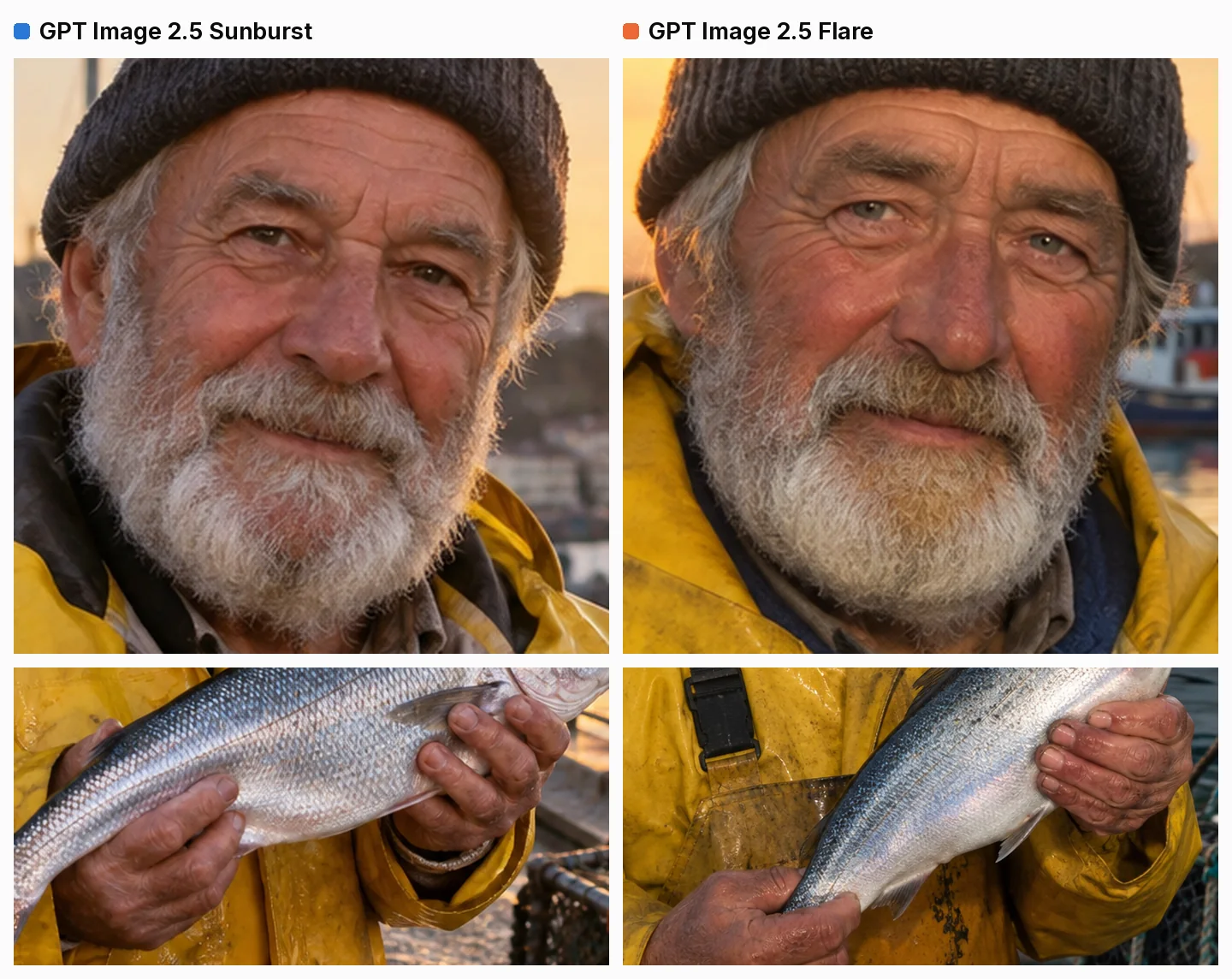
What we saw. The two men could be brothers: grey beard, knit hat, yellow oilskin, silver fish, boats, low sun. Sunburst’s is the kinder portrait, with brown eyes creased in a smile, a soft white beard, smoother skin and warm, even light. Flare’s is harder: blue-grey eyes, a red, weathered nose, deep furrows, a beard yellowed round the mouth, braces over the jacket and raw, wet-looking hands. Both pairs of hands are believable, with knuckles, creases and dirt in the lines. Flare also lettered WD 326 on the boat behind him.
2. Two people, four colours: the girl and the boy
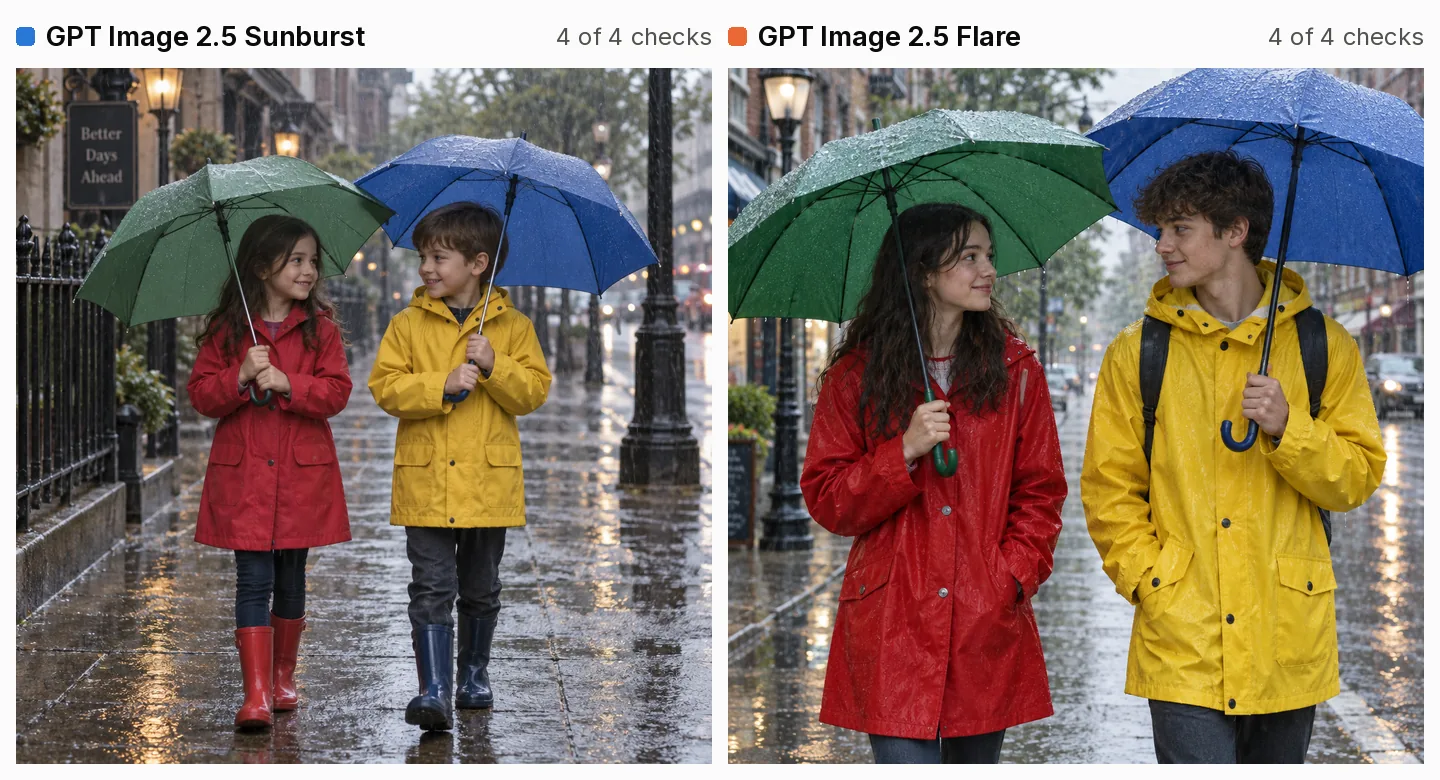
What we saw. The biggest difference in the test is age. Sunburst drew two young children, full length, in wellies, under a sign reading “Better Days Ahead”. Flare drew two teenagers from the thighs up, raindrops beaded on their coats and cars in the street. The prompt only said “girl” and “boy”, so both are right; if you mean children, say so. In both, the two look at each other, with natural faces and no doubled or melted features.
3. Hands on a piano
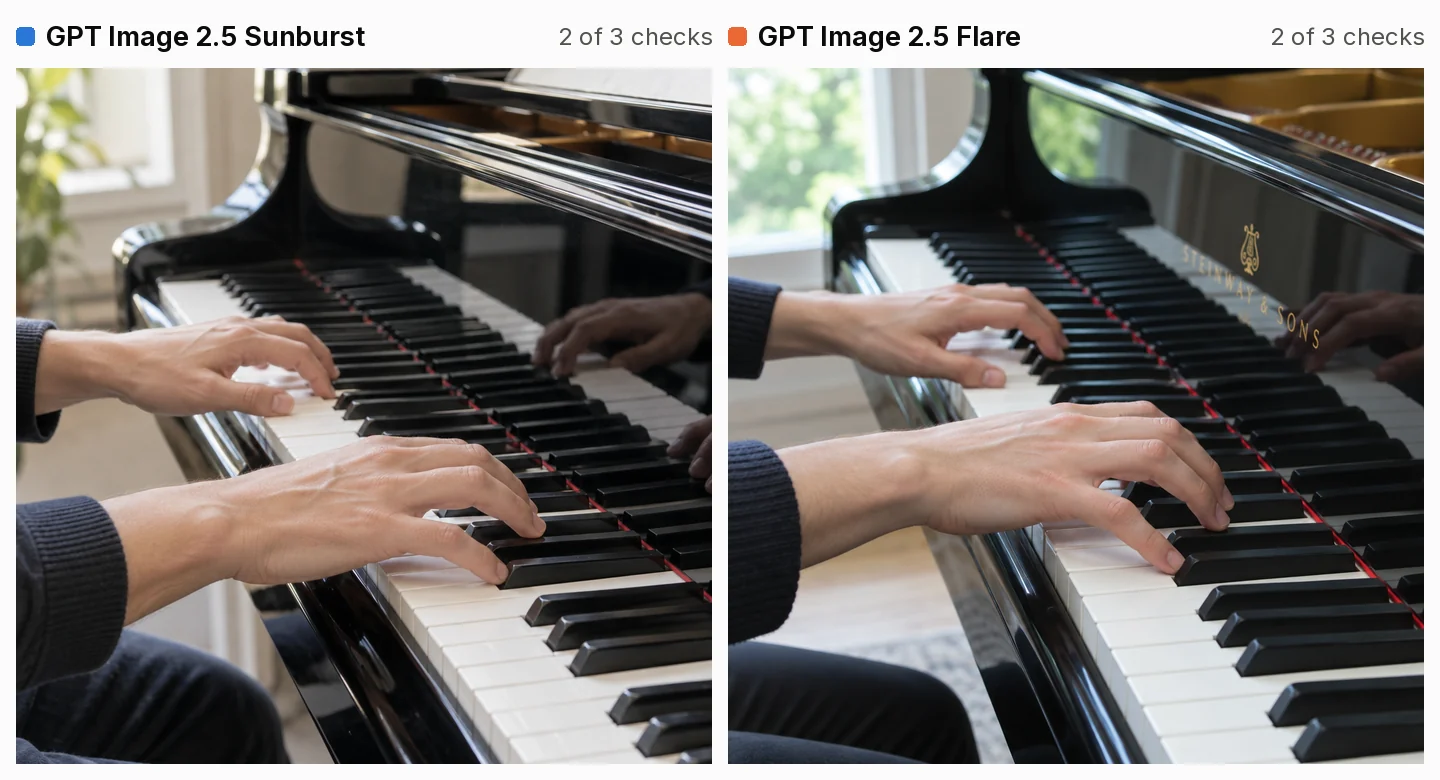
What we saw. Nearly the same photograph twice: hands from the left in dark sleeves, a red felt strip, window light, reflections in the fallboard. At normal size both pairs look natural; Sunburst’s are veinier and older. Up close, no hand in either picture shows all five fingers, and you cannot tell whether the rest are hidden or missing. Our first two judges split on that for both pictures; a third, told that a finger hidden by the angle is not a missing one, passed both. Flare also painted a real maker’s name and logo, Steinway & Sons, spelt correctly and never asked for. Check for trademarks like that if a picture is for commercial use.
4. A shop sign and a chalkboard
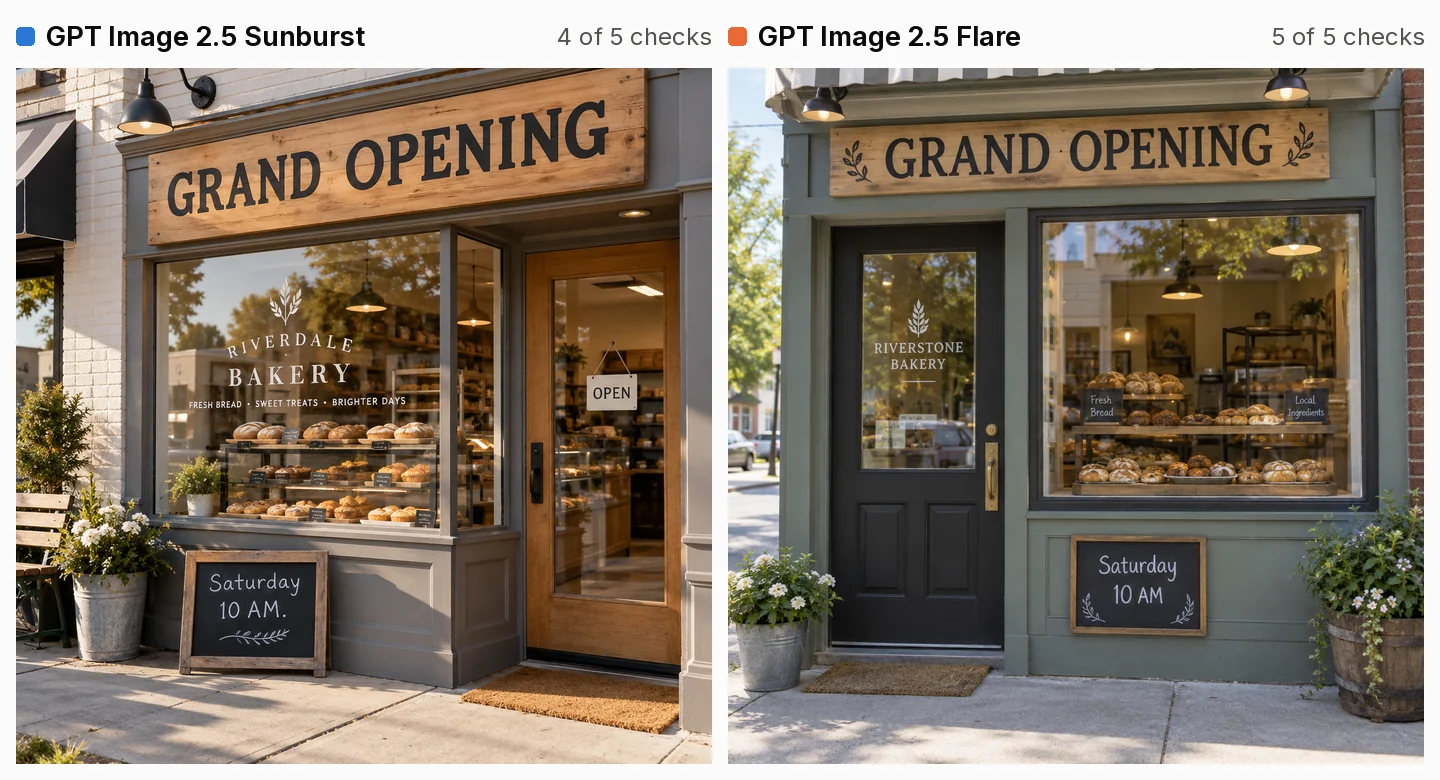
What we saw. Both invented a bakery name and spelt it right: Riverdale for Sunburst, Riverstone for Flare. Sunburst lit the street with low, golden sun; Flare’s daylight is brighter and cooler. Sunburst’s board reads “10 AM.”, with the full stop that ends our prompt. OCR, which ignores punctuation, passed it; the judges, asked whether the board read exactly “Saturday 10 AM”, said no.
5. A three-line poster
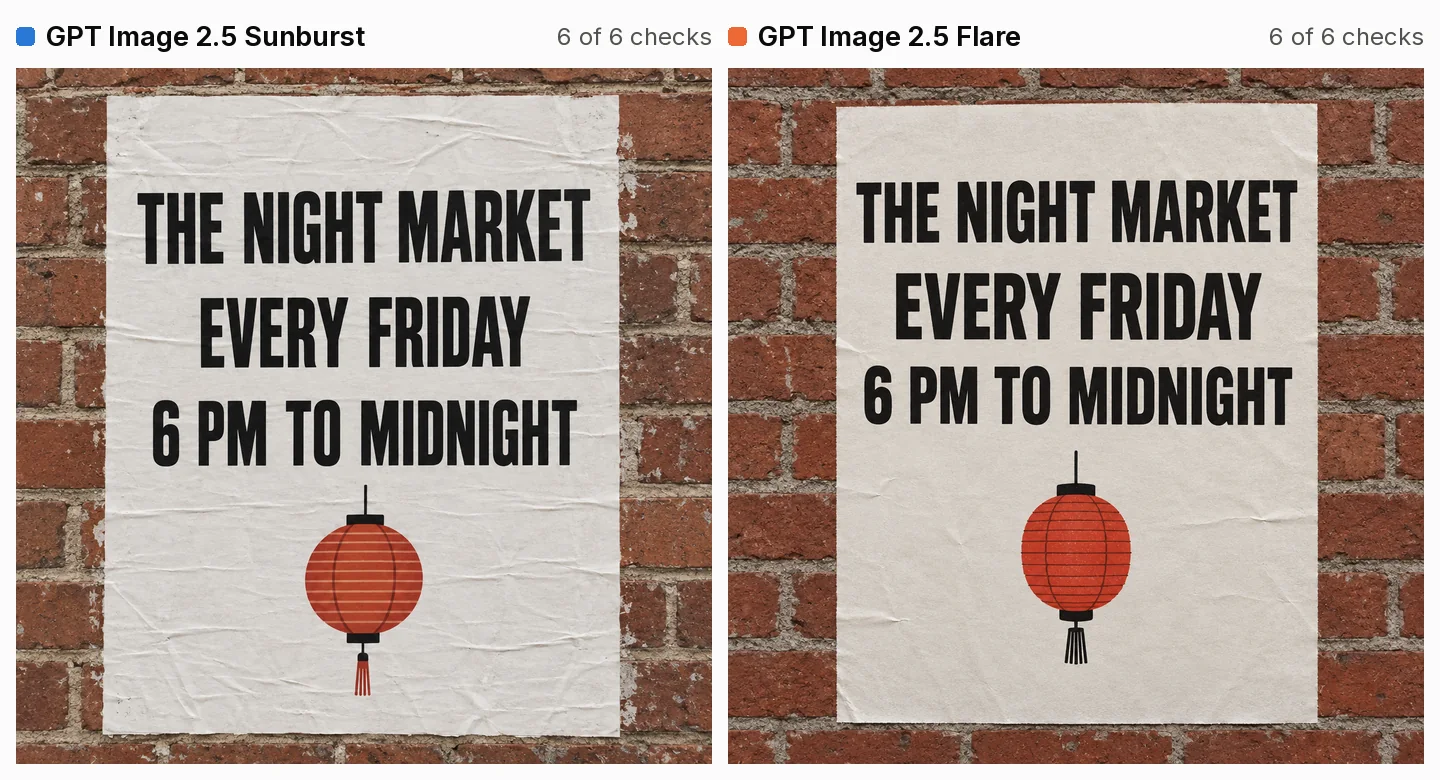
What we saw. The same design twice, down to the type and the lantern. Sunburst’s paper is creased like a freshly pasted poster; Flare’s is flatter.
6. Ukrainian on a chalkboard
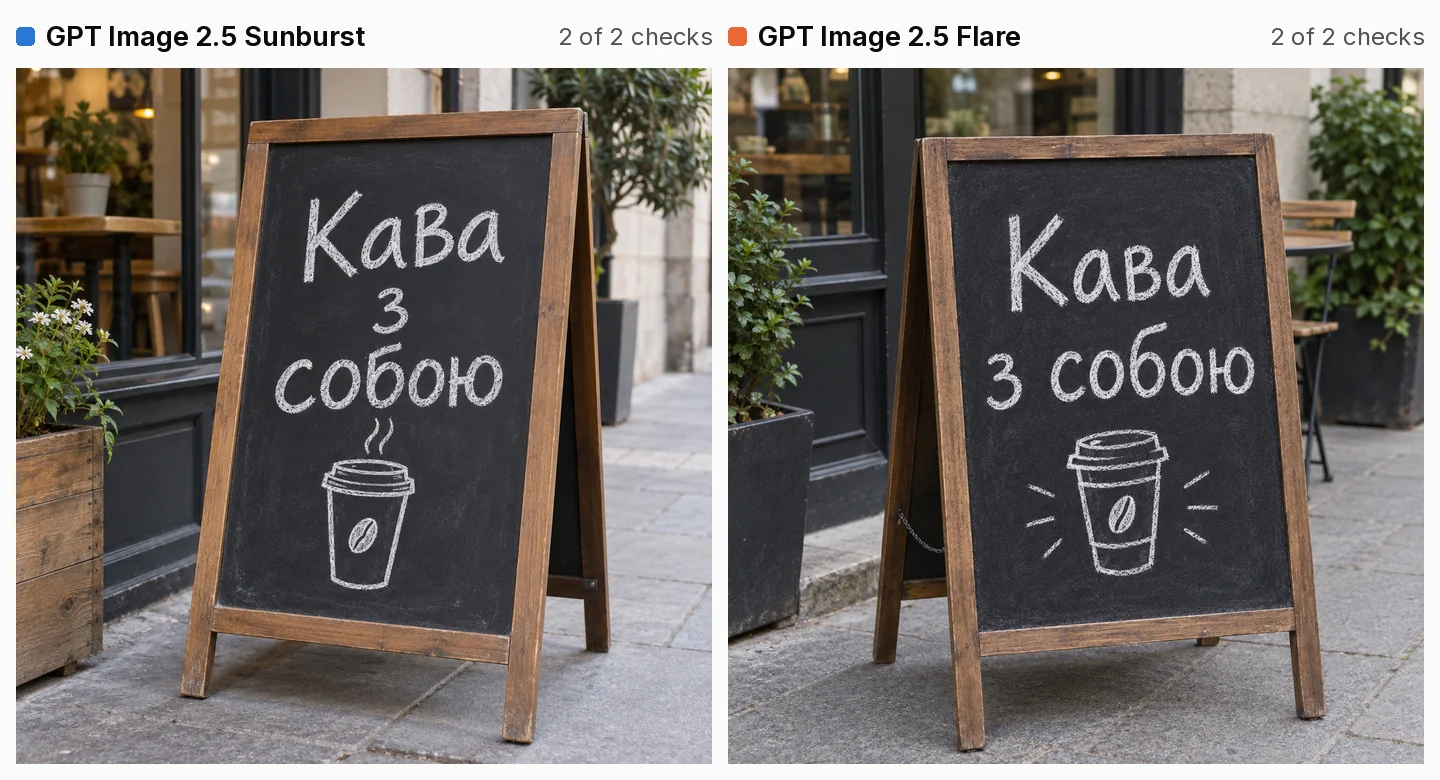
What we saw. Both spelt Кава з собою (“coffee to go”) right, in convincing chalk: Sunburst over three lines, Flare over two.
7. A product photo with a brand name
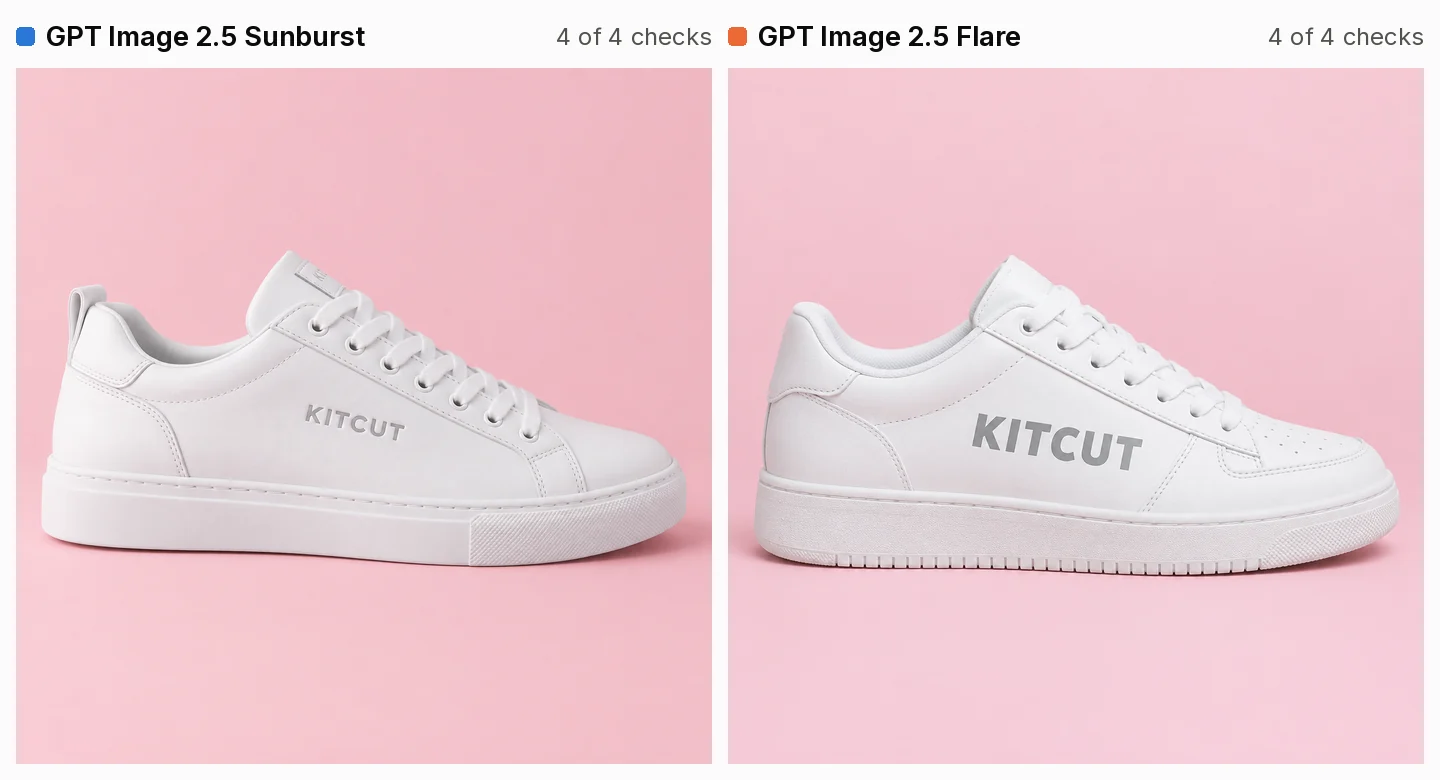
What we saw. Sunburst made a slim court shoe with a small, foil-like KITCUT: it could pass for a real product shot. Flare made a chunkier basketball shoe with a big grey print.
8. A three-step diagram
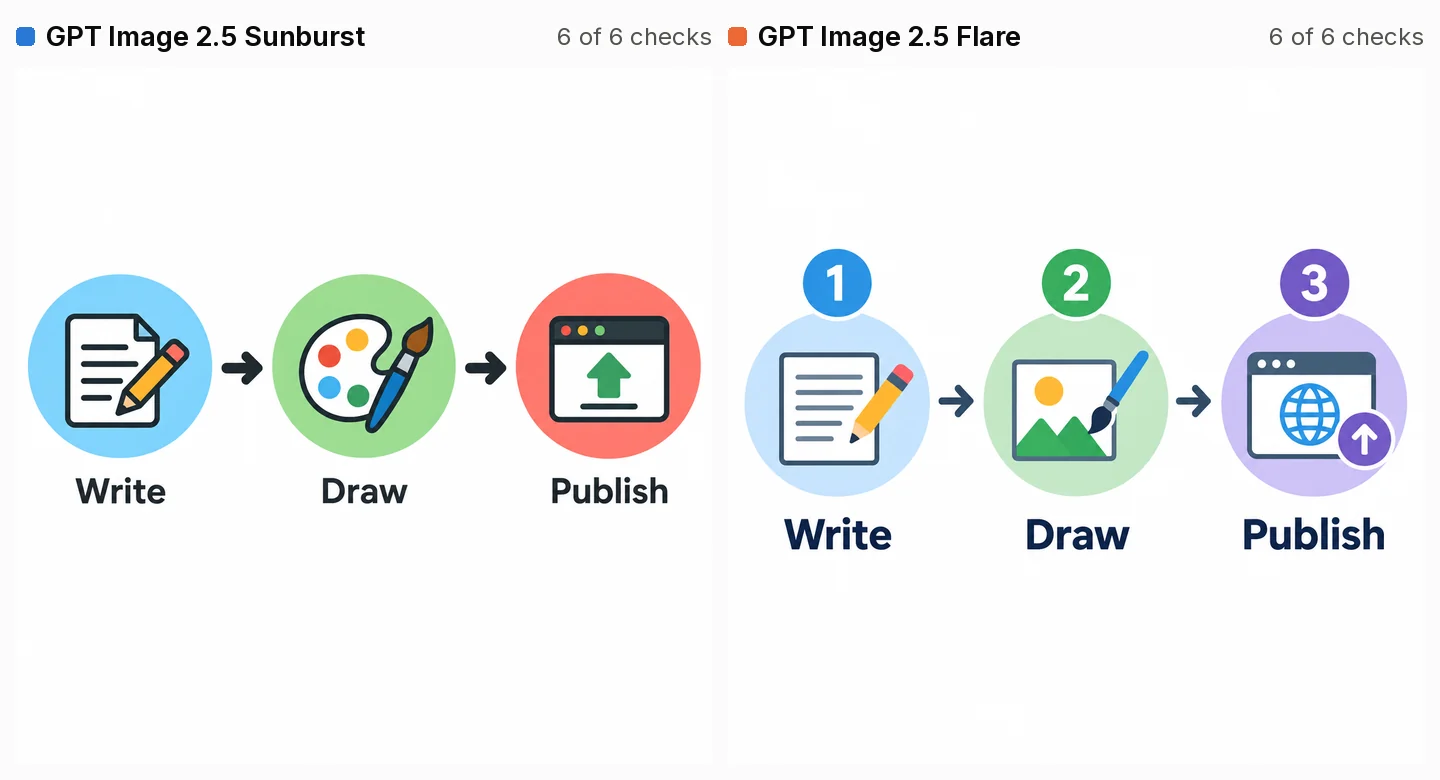
What we saw. Clean flat icons in both. Flare added numbered badges that nobody asked for; Sunburst used stronger colours.
9. Where things go: a mug, a book and a pen
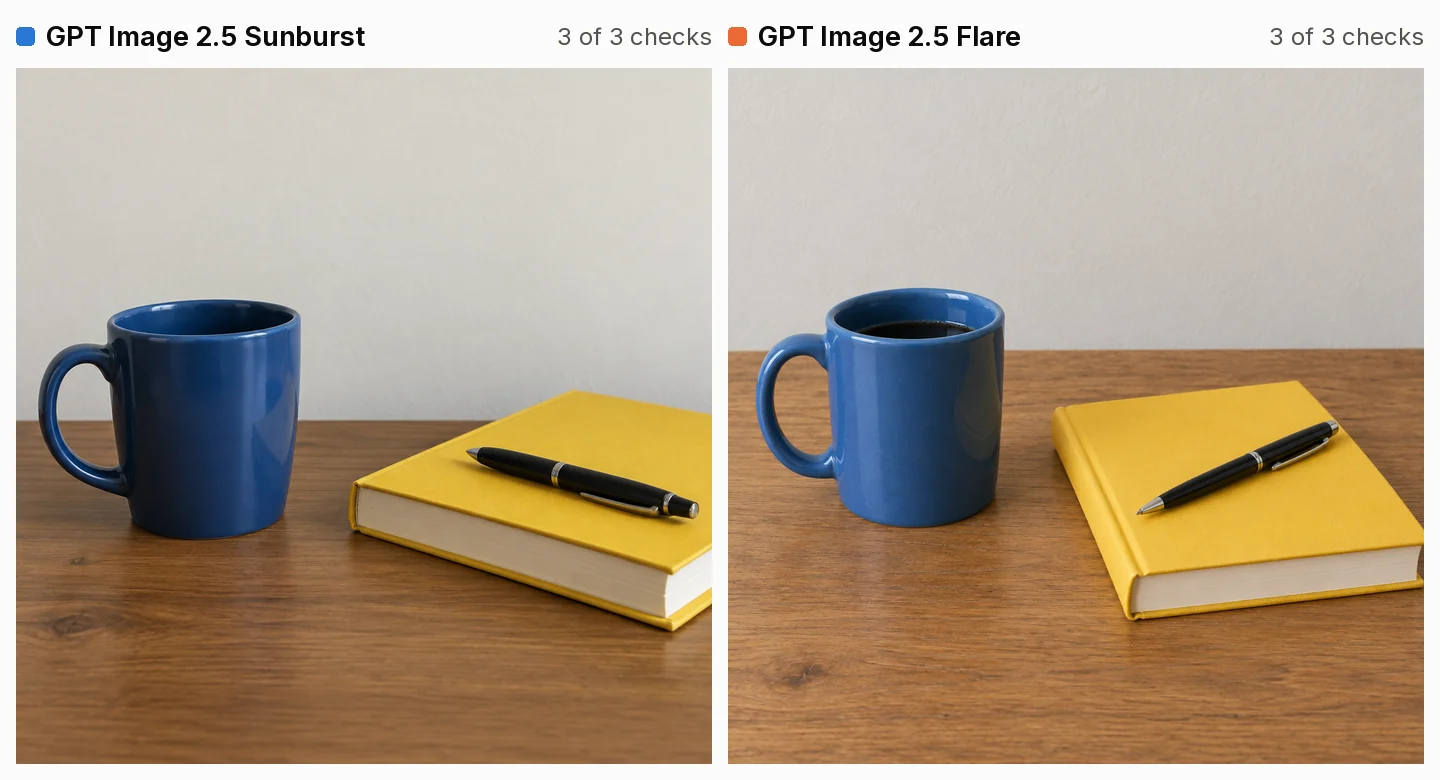
What we saw. Sunburst’s mug is deep navy, its book running off the edge; Flare’s mug holds coffee, and its book is in frame.
10. Counting fruit
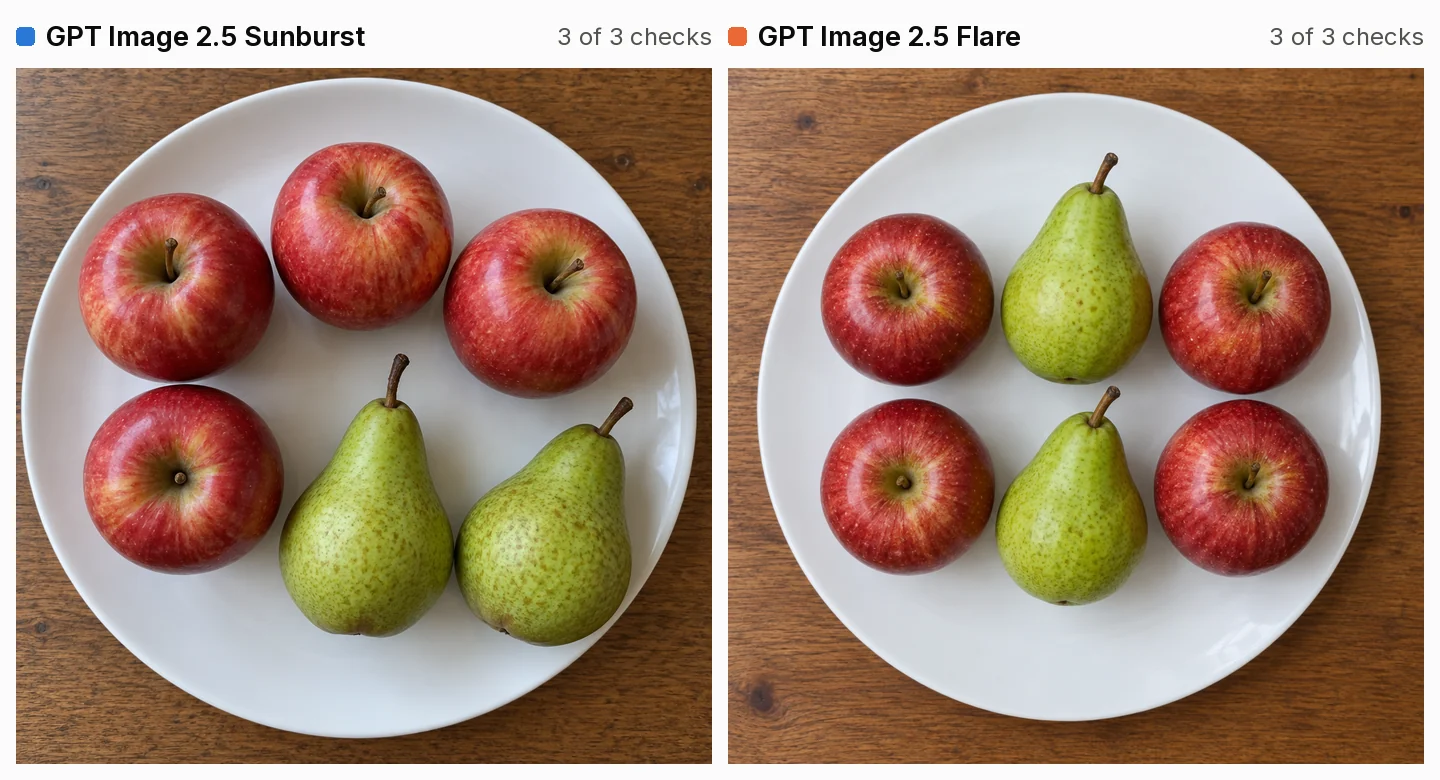
What we saw. Sunburst set the fruit out loosely under window light; Flare laid it in a symmetrical grid.
11. An empty street, with nothing in it
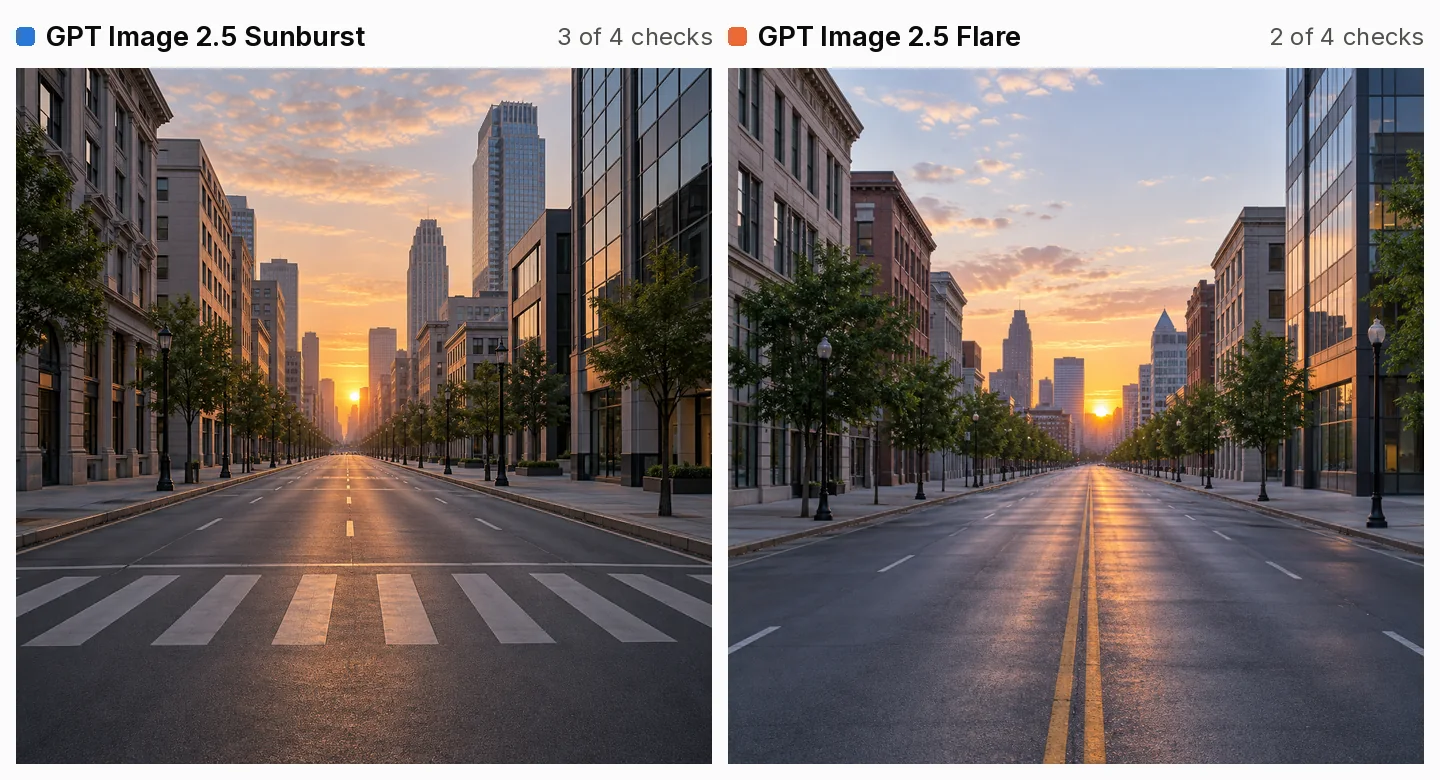
What we saw. The same postcard twice: an avenue running to a sunrise between towers. Look closely and both have traffic at the vanishing point, and Flare hung blank plates on two poles on the left. Asking for nothing is hard.
12. A watercolour fox
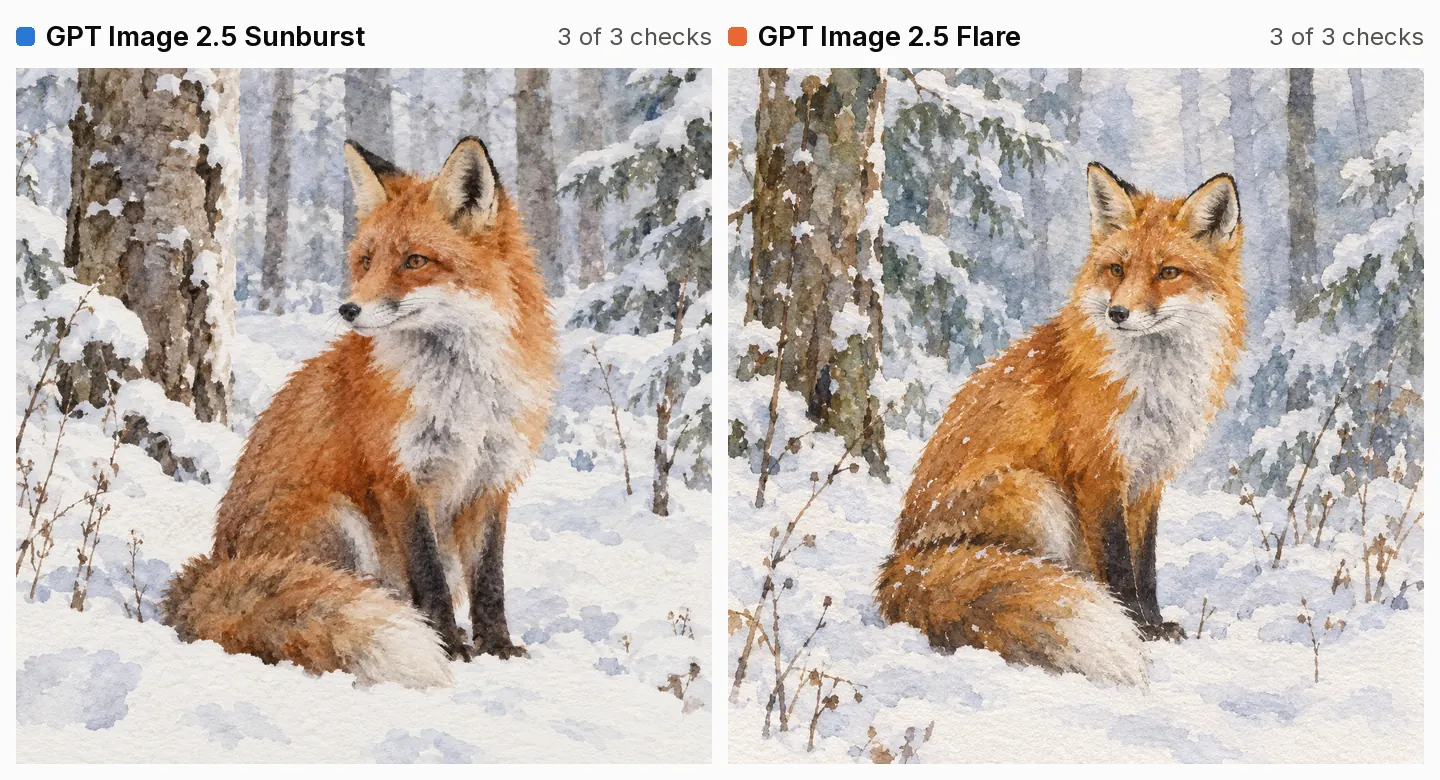
What we saw. Two convincing watercolours, paper grain and all; both passed every check. Up close, Sunburst’s fur is fine, blended strokes and Flare’s is flat, hard-edged dabs. That is one picture each, at medium quality, but our painting bake-off on 26 September (72 pictures on 8 models, at other settings) found the same: Flare composed well for $0.009 a picture and about 14 seconds, but its textures looked blocky at full size.
Is Sunburst better than Flare? Our scores
Both passed 45 of the 48 checks. They differ on two. Sunburst alone failed one check on the bakery sign (“chalkboard reads exactly Saturday 10 AM”). Flare alone failed one check on the empty street (“no signs, letters or text”). Both failed one check on the piano (“regular keys, black ones in twos and threes”) and one check on the empty street (“no cars or other vehicles”).
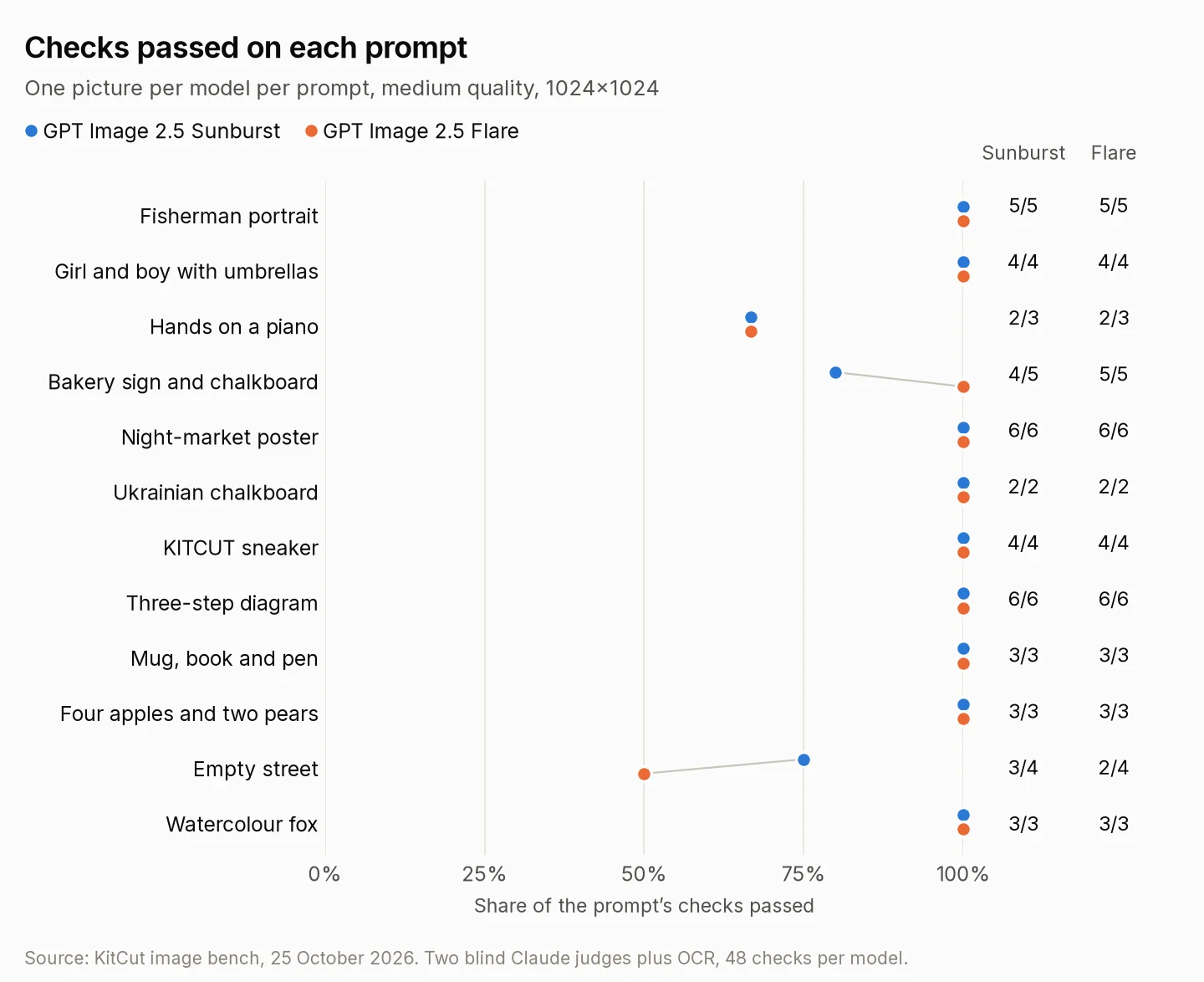
| Prompt | Sunburst | Flare |
|---|---|---|
| Fisherman portrait | 5 of 5 | 5 of 5 |
| Girl and boy with umbrellas | 4 of 4 | 4 of 4 |
| Hands on a piano | 2 of 3 | 2 of 3 |
| Bakery sign and chalkboard | 4 of 5 | 5 of 5 |
| Night-market poster | 6 of 6 | 6 of 6 |
| Ukrainian chalkboard | 2 of 2 | 2 of 2 |
| KITCUT sneaker | 4 of 4 | 4 of 4 |
| Three-step diagram | 6 of 6 | 6 of 6 |
| Mug, book and pen | 3 of 3 | 3 of 3 |
| Four apples and two pears | 3 of 3 | 3 of 3 |
| Empty street | 3 of 4 | 2 of 4 |
| Watercolour fox | 3 of 3 | 3 of 3 |
| All 12 prompts | 45 of 48 | 45 of 48 |
The two percentages still differ because our headline score averages the 12 prompts’ shares of checks passed, so a miss on a prompt with four checks costs more than one on a prompt with five or six: Sunburst scores 93.5% and Flare 93.1%. By ability, they differ only on text (Sunburst 22 of 23, Flare 23 of 23) and on leaving things out (Sunburst 3 of 4, Flare 2 of 4); on the other six abilities their results are the same.
OpenAI calls Sunburst its most capable model. On new pictures from a prompt at medium quality, our checks could not separate the two; the arena voters, comparing pictures at max quality, give Sunburst a small edge.
Which is faster, Sunburst or Flare?
Flare. In our test it was faster on all 12 prompts: a median of 10.6 seconds a picture against 15.7 for Sunburst, and 130 seconds for all 12 pictures against 178.
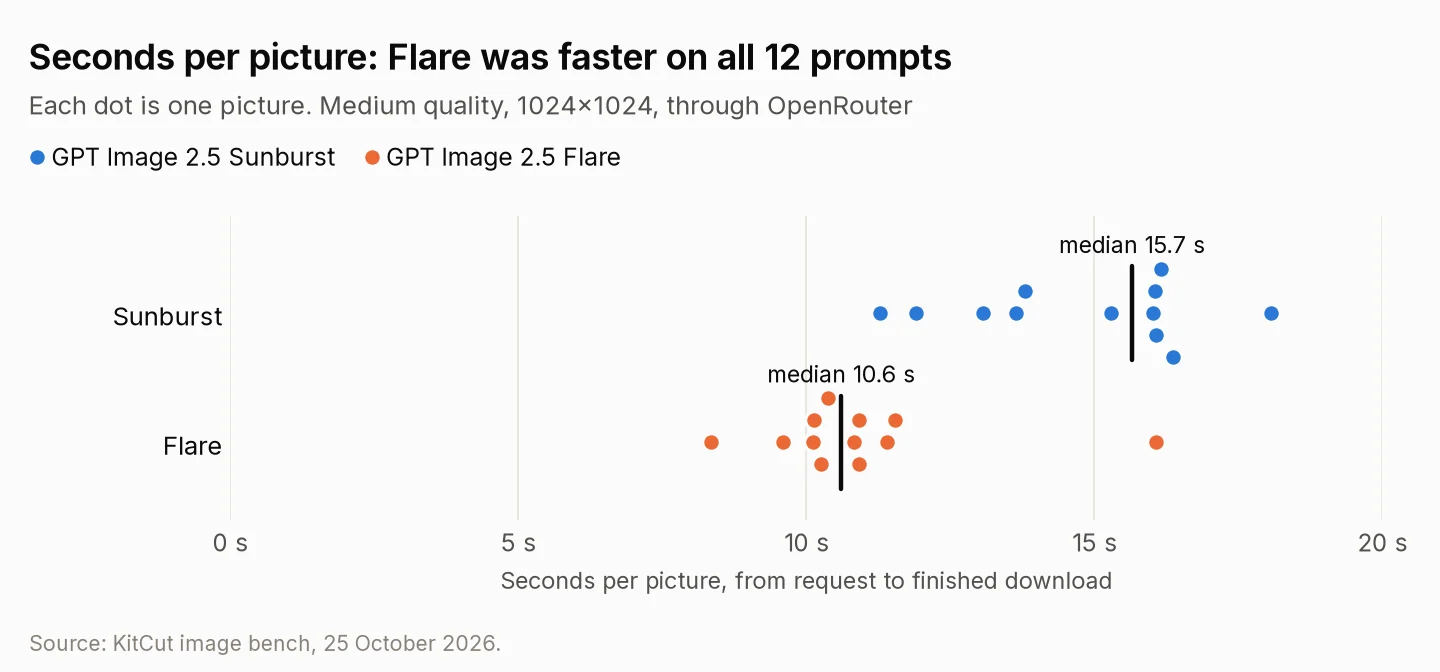
| Prompt | Sunburst, seconds | Flare, seconds |
|---|---|---|
| Fisherman portrait | 18.1 | 10.9 |
| Girl and boy with umbrellas | 16.1 | 11.4 |
| Hands on a piano | 16.1 | 10.1 |
| Bakery sign and chalkboard | 16.1 | 10.3 |
| Night-market poster | 13.1 | 10.8 |
| Ukrainian chalkboard | 16.0 | 11.5 |
| KITCUT sneaker | 11.9 | 10.1 |
| Three-step diagram | 13.6 | 8.3 |
| Mug, book and pen | 11.3 | 10.9 |
| Four apples and two pears | 13.8 | 10.4 |
| Empty street | 15.3 | 9.6 |
| Watercolour fox | 16.4 | 16.1 |
| Median of 12 | 15.7 | 10.6 |
| Fastest and slowest | 11.3 to 18.1 | 8.3 to 16.1 |
| All 12 together | 178 | 130 |
At max quality the gap is wider. Artificial Analysis times both through OpenAI’s own API at max quality, as a median over the past three days: 53.1 seconds for Flare and 115.3 for Sunburst, more than twice as long. OpenAI’s guide warns that “complex prompts may take up to 2 minutes to process”. Times vary with route, hour and setting, so compare the two models within a row, not across rows.
| Median seconds a picture: who measured, and how | Sunburst | Flare | Ratio |
|---|---|---|---|
| Our test: medium quality, 1024×1024, through OpenRouter, median of 12, 25 October 2026 | 15.7 | 10.6 | 1.5× |
| Artificial Analysis: max quality, through OpenAI, median of the past 3 days, read 25 October 2026 | 115.3 | 53.1 | 2.2× |
Sunburst vs Flare for editing, characters and cut-outs
The 12-prompt test only makes new pictures. Much of what KitCut does with these models is editing: drawing a character once, then redrawing it with a new face, mouth or pose for an animated film. Each of our measurements from that work was made at its own settings, so compare the two models within a measurement, not prices across them.
Characters: Sunburst drifted less in our test
On 17 October we gave seven models the same character brief and asked each to change only the face, one edit at a time. Drift is the share of the figure outside the head that changed anyway; lower is steadier. It is one character, and our notes do not record how many edits each range covers.
| Model | Drift on face edits | Note |
|---|---|---|
| GPT Image 2.5 Sunburst | 0.4–1.8% | draws a real transparent background; our default |
| GPT Image 2.5 Flare | 0.9–3.5% | |
| Gemini 3 Pro Image (Nano Banana Pro) | 0.4–0.9% | $0.136 a picture in that test, against Sunburst’s $0.019; no transparent background |
| MAI-Image 2.6 | 0.2–1.7% | once its redraws were aligned (they come back about 2.5% larger and shifted) |
| Grok Imagine Image 2.0 | 0.2–1.2% | once aligned; 57 s a picture |
| Gemini 3.1 Flash Image (Nano Banana 2) | 1.5–3.4% | |
| Muse Image | – | unusable: it takes no reference picture, so every picture was a different character |
Our pipeline sends back any face edit that drifts more than 2.5%: Sunburst’s worst stayed under that line, Flare’s worst would have gone back. Gemini 3 Pro Image was steadier still, but cost about seven times as much a picture and draws no transparent background. So Sunburst is our default for characters: a 45-piece character, with 8 faces, mouth shapes, blinks and 10 poses, cost $1.13 and took 4 minutes 19 seconds. The cost includes three first designs to choose from, at $0.023 a picture.
Transparent edits: ask for white
We draw each character’s first picture with Sunburst on a transparent background. Asked for transparent edits too, it returned a cloudy, half-transparent halo round the figure about half the time (our drift measure read 40–160%), and every retake was wasted. The same edits on white keyed off cleanly, at 0.0–0.3% drift: in the 45-piece character above, all 35 edits our pipeline checks came back in that range at the first try. We did not record how many transparent edits we tried first. So new pictures can be transparent; edits we ask for on white.
Cut-outs: Flare
Flare paints the paper cut-outs in our collage films on a real transparent background: 17 for one example film, at medium quality, for $0.197 in all ($0.0107–0.0137 each), in 78 seconds, four at a time. One came back with a white paper shape behind it; “drawn alone with nothing behind it” in its prompt fixed that, on a repaint costing $0.011.
People from a photo: Flare
To turn a real person into a character, such as a toy-brick figure, a clay model or a stippled newspaper portrait, Flare redraws them from their photo, then edits that picture four times for mouth shapes and closed eyes. On three people and a painting the likeness held in every look, and the edits lined up within 0.1–0.4 pixels, which is enough when only a patch round the mouth or eyes is kept. A character takes five pictures, $0.11 and 30–60 seconds; a casting portrait of a made-up character, about $0.01 and 10 seconds a role. Why we draw people rather than fake them: drawn, not deepfaked.
Sunburst or Flare: which should you use?
- Editing a picture, or keeping one character the same across many: Sunburst. It drifted less in our face edits on the one character we tested, leads the editing arena, and is OpenAI’s own pick for editing.
- Many pictures, or someone waiting for each one: Flare. The same price for a quarter to a third less time at medium quality, and less than half the time at max.
- Cut-outs on a transparent background: Flare, in our experience: cheap, quick and clean.
- Edits on a transparent background: ask for white and key the background out yourself. That fixed Sunburst’s halos for us; we have not measured Flare’s transparent edits.
- Small edits you will cut out anyway, such as a mouth or an eye: Flare is fine, and quicker.
- Text, counting, colours and placement at medium quality: either. Both spelt every word we asked for correctly, in English and in Ukrainian; Sunburst’s one text miss was a full stop copied from our prompt.
- Saving money: the version will not help. The quality setting will: from $0.006 a picture at low to $0.211 at max.
How we tested, and the limits
We made the pictures on 25 October 2026 through OpenRouter’s image API, with six other models; all eight are compared in Best AI image generator 2026. Each model got the same 12 prompts at medium quality, square, one picture each. The prompts carry 48 checks, two to six each: 38 yes-or-no questions and 10 OCR readings of the text. Two Claude Opus 5.5 judges answered separately, seeing each prompt’s pictures shuffled and lettered, never the model names, and told to answer no when unsure. Across all eight models the two judges gave the same answer 95.7% of the time, on 304 paired answers (Cohen’s kappa 0.72, which corrects for chance agreement); a third judge settled the other 13. The full method is in How we test AI image models.
- Too few pictures. Twelve prompts with one picture each is too few to separate two models this close: they differ on two of 48 checks, and a second run could reverse that.
- One setting. Medium quality at 1024×1024 only; the arena results are at max.
- New pictures only. The 12-prompt test has no edits; our editing evidence comes from production work at other settings.
- One route, one day. The times are through OpenRouter on 25 October 2026, six requests at a time. Yours will differ.
- A machine judge. Claude reads pictures well but not perfectly, and answering no when unsure costs a borderline picture its check.
FAQ
What is the difference between GPT Image 2.5 Sunburst and Flare?
Speed, and steadiness when editing. Flare is the fast one: a median of 10.6 seconds a picture against 15.7 in our test at medium quality. Sunburst is OpenAI’s pick when editing precision matters, and on the one character we tested it changed less than Flare when told to change only the face. Prices, endpoints and settings are the same.
Is GPT Image 2.5 Sunburst better than Flare?
Not measurably on our checks: both passed 45 of 48, differing on two. Artificial Analysis’s arena voters prefer Sunburst by 15 Elo points for new pictures and 17 for edits, at max quality. For most new pictures, Flare’s speed matters more than that gap.
How much does GPT Image 2.5 cost?
Both versions cost $30 per million image output tokens, $8 per million image input tokens and $5 per million text input tokens, and half that through the Batch API. A 1024×1024 picture costs about $0.006 at low quality, $0.013 at medium, $0.053 at high, $0.094 at xhigh and $0.211 at max.
Which is faster, Sunburst or Flare?
Flare. It was faster on all 12 of our prompts at medium quality, with a median of 10.6 seconds against 15.7. At max quality, Artificial Analysis measures 53.1 seconds against 115.3.
Can GPT Image 2.5 make transparent backgrounds?
Yes, both versions can: set the background to transparent and ask for PNG or WebP. Flare’s transparent cut-outs worked well for us. Sunburst’s transparent edits often came back with a cloudy halo, so we ask for edits on white and remove the background ourselves.
Which should I use for editing and consistent characters?
Sunburst. On the one character we tested, told to change only the face, it changed 0.4–1.8% of the rest of the figure, against 0.9–3.5% for Flare, and it leads Artificial Analysis’s editing arena. For small edits that you cut out anyway, Flare works and is quicker.